Why Lithium-Ion Batteries Age: The Chemistry Behind Capacity Loss
Every lithium-ion battery starts dying the moment it's made. The chemistry that stores energy also slowly destroys the cell — and heat, voltage, and time accelerate the process. During each charge, lithium ions move from cathode to anode.
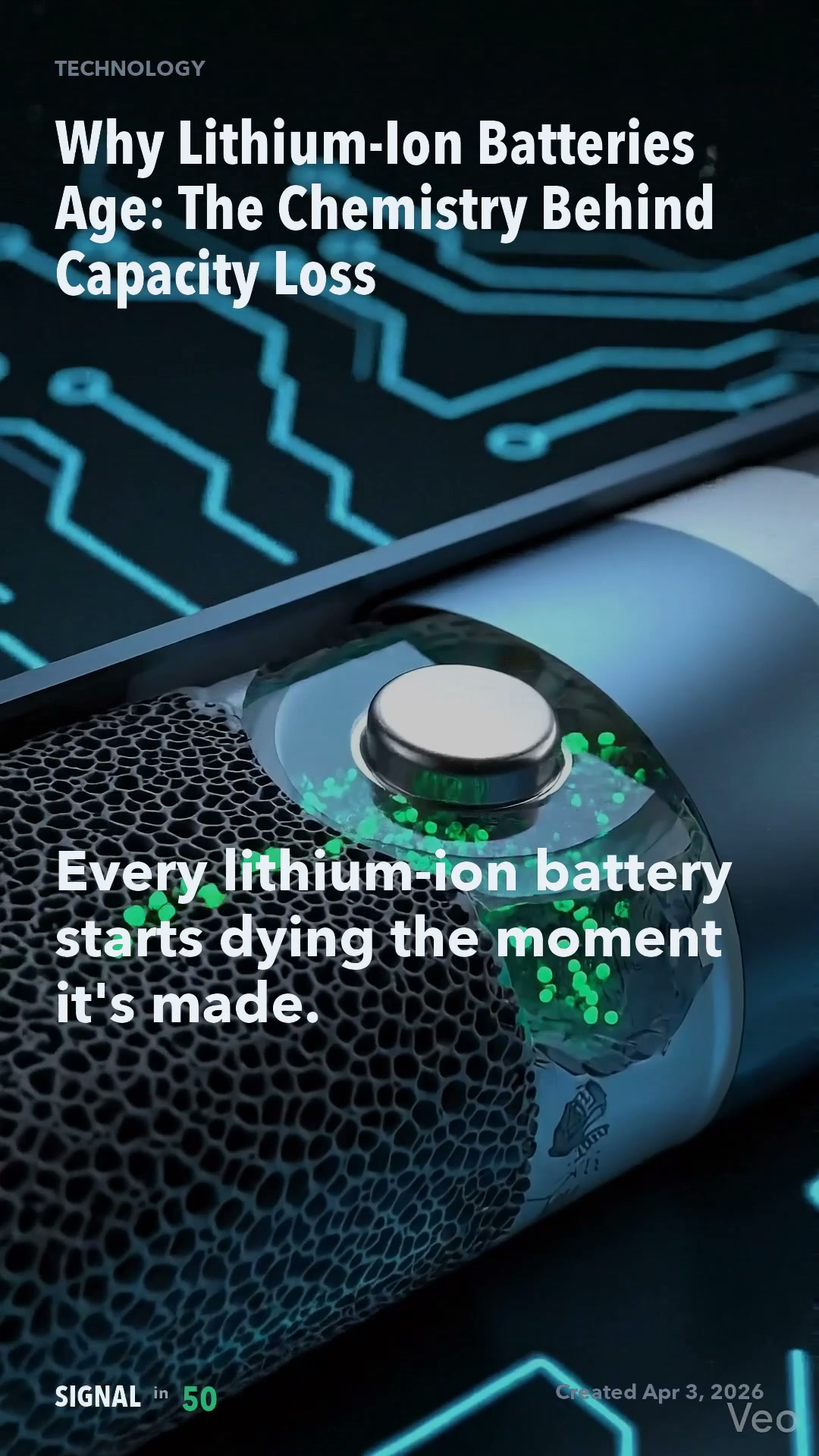
Every lithium-ion battery starts dying the moment it's made. The chemistry that stores energy also slowly destroys the cell — and heat, voltage, and time accelerate the process.
During each charge, lithium ions move from cathode to anode. But some react with the electrolyte, forming a solid layer called the SEI. This layer grows thicker with every cycle, trapping ions that never return.
Meanwhile, the anode expands and contracts with each charge, cracking its structure. After 500 cycles, a typical cell has lost 20 percent of its original capacity — not from use, but from chemistry.
Heat above 30 degrees Celsius doubles the degradation rate. Full charge accelerates SEI growth even when the device is off. The practical rule: keep charge between 20 and 80 percent, and keep the battery cool. The chemistry doesn't care what brand you bought.
Key facts
- Lithium-ion cells age when side reactions build a thicker SEI layer.
- Stress electrodes over repeated charge cycles.
- Long full-charge storage speed this process.
- Chemistry facts still apply regardless of phone model.
- The chain from cause to effect.
Why it matters
Not a vague description of the result. A strong explainer isolates the mechanism, the visible outcome, and the common misconception.
The Signal Brief
One sourced idea worth your attention, in your inbox. No noise.