The Hidden Mechanism Behind Lithium-Ion Cells
Crazy part: a lithium-ion battery does not fill with electricity. When you plug in, charging starts by rearranging particles, forcing electrons one way and lithium ions another, inside a tiny layered cell built to keep them apart. Here is the setup.
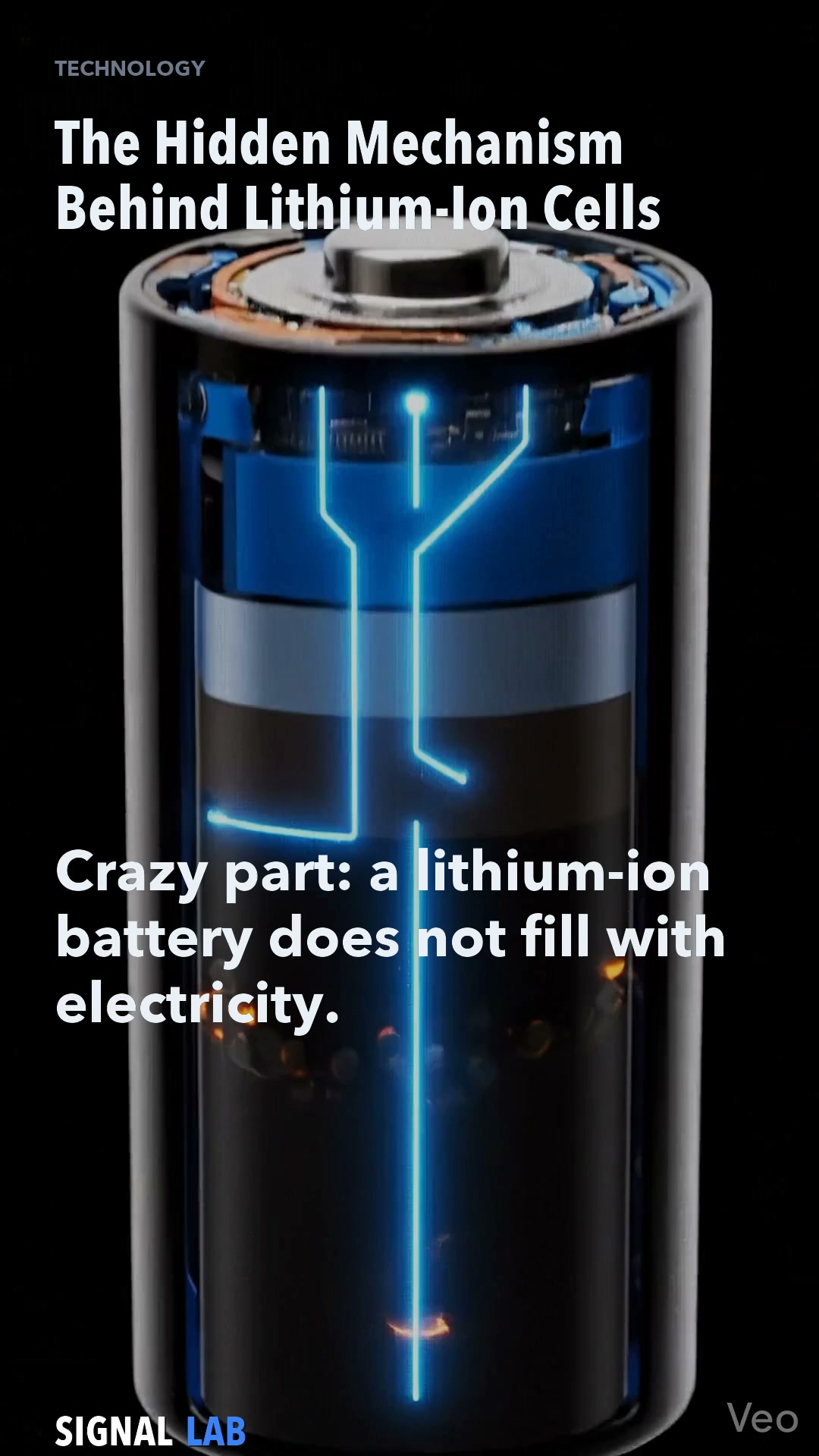
Crazy part: a lithium-ion battery does not fill with electricity. When you plug in, charging starts by rearranging particles, forcing electrons one way and lithium ions another, inside a tiny layered cell built to keep them apart.
Here is the setup. A battery is a chemical machine, not a storage bucket. Inside, a metal-oxide cathode, a graphite anode, and a thin separator create two sides that can hold energy in an unnatural, controlled arrangement.
Then the trick happens. Electrons cannot cross that separator, so the charger drives them through the outside wire. To balance charge, lithium ions drift through the electrolyte inside, crossing pores while the separator blocks a dangerous internal shortcut.
At the graphite side, lithium slips between carbon layers instead of coating the surface. That packed, higher-energy arrangement is the charge. So recharging is really controlled particle traffic, repeated carefully until heat, strain, and wear start winning.
Key facts
- A 12-scene mechanism-first documentary on how lithium-ion cells store and release energy by separating the paths of electrons and lithium ions across layered materials.
- The story begins with the familiar low-battery crisis.
- Then follows charging from the cathode through the wire.
- And graphite anode before reversing the trip during use.
- It ends on the tradeoff that makes portable power possible: dense energy storage depends on tightly controlled particle movement inside fragile.
Why it matters
Repeatable chemistry. When a phone falls to one percent.
The Signal Brief
One sourced idea worth your attention, in your inbox. No noise.