How a Touchscreen Detects Your Finger
Your phone screen has no button underneath it. Beneath the glass sits an invisible grid of ultra-thin conductive channels, each one carrying a tiny electric field. That field is what actually detects your finger — not pressure, not heat.
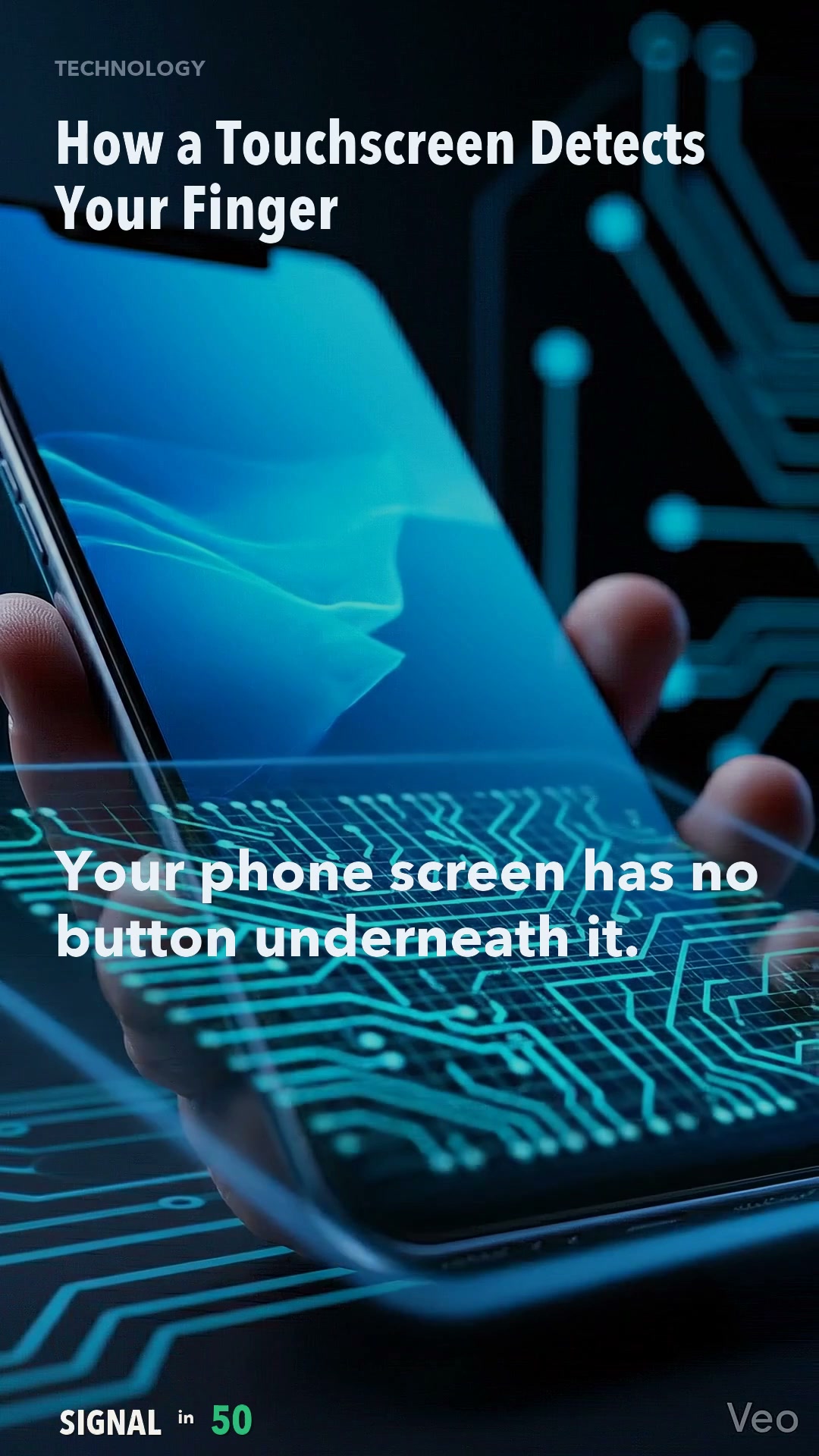
Your phone screen has no button underneath it. Beneath the glass sits an invisible grid of ultra-thin conductive channels, each one carrying a tiny electric field. That field is what actually detects your finger — not pressure, not heat.
Before you touch anything, electric field lines arc between horizontal and vertical channels at every intersection. The controller measures capacitance at each crossing point thousands of times per second, building a live electrical map of the entire surface.
The instant your fingertip lands, your body's water and ions absorb some of that local field energy. Capacitance drops at the nearest intersections, and the controller reads the pattern of disturbed nodes to pinpoint exact coordinates — accurate to within a single millimeter.
This is why regular gloves kill your screen. The fabric blocks your skin's conductivity from reaching the grid. Conductive-thread gloves restore that electrical bridge. Every tap, swipe, and pinch you perform depends on your body completing a circuit it never feels.
Key facts
- A capacitive touchscreen does not feel pressure like a button.
- It senses how your finger changes an electric field across a conductive grid and converts that disturbance into coordinates.
- Strong visual and audience validation.
- Branch Education and TED-Ed both show million-level interest.
- A recent ElectroBOOM upload suggests the concept still performs.
Why it matters
Probe identifies the best hook as why fingers work. Normal gloves often do not.
The Signal Brief
One sourced idea worth your attention, in your inbox. No noise.