Rainbows: How Sunlight Splits in Raindrops
A rainbow isn't a fixed object in the sky. It's an optical effect that exists only at a precise angle between sunlight, raindrops, and your eyes. Every drop acts as a tiny prism, bending white light the moment it enters.
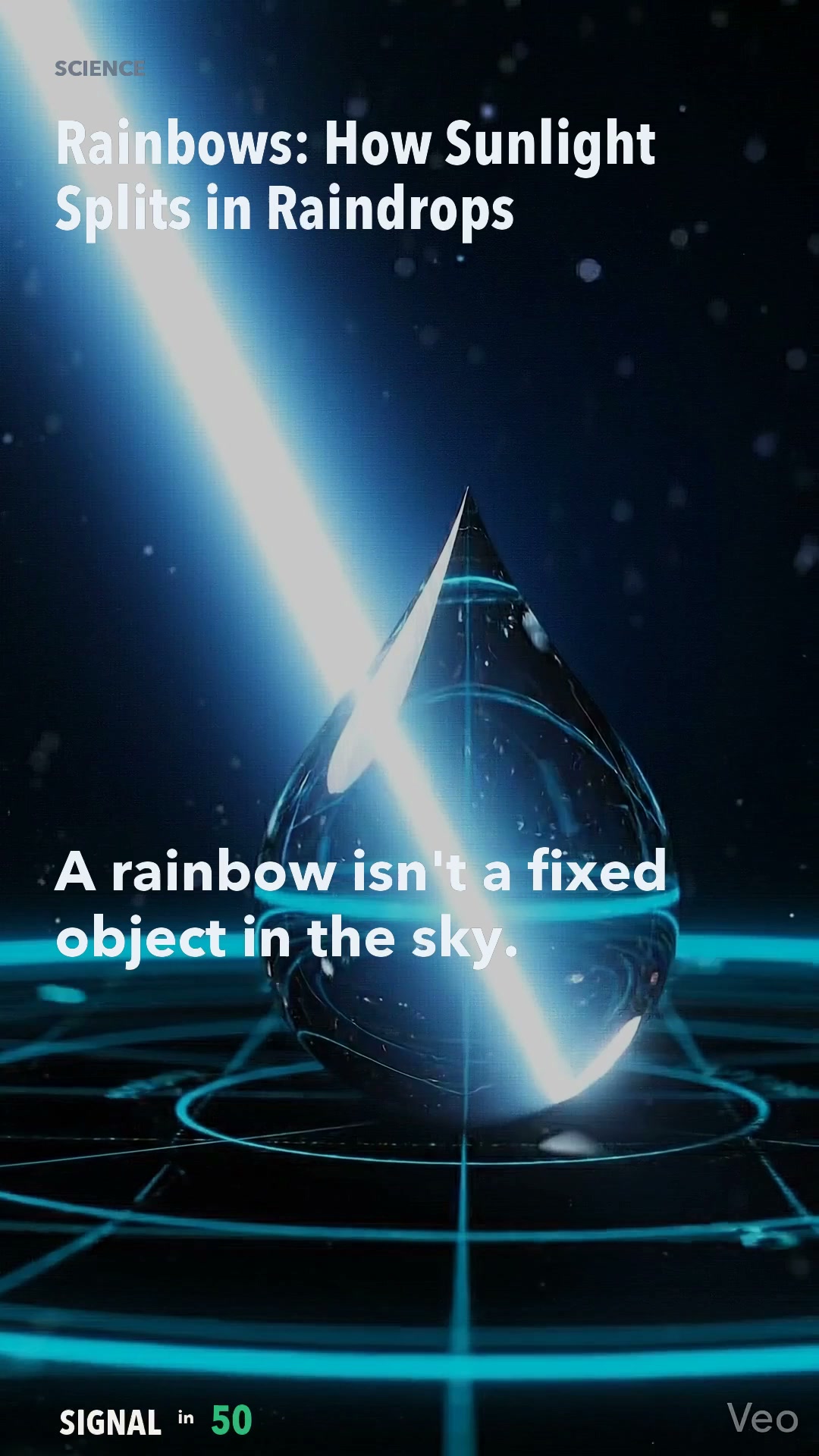
A rainbow isn't a fixed object in the sky. It's an optical effect that exists only at a precise angle between sunlight, raindrops, and your eyes. Every drop acts as a tiny prism, bending white light the moment it enters.
Inside each raindrop, light slows and refracts, then bounces off the back wall like a mirror. On exit it refracts again, and this double bend splits white light into its component colors. Red exits at forty-two degrees, violet at forty.
Multiply that by millions of falling drops. Each one sends a single narrow color toward your eye from its position. Red arrives from higher drops, violet from lower ones. Your brain stitches those individual flashes into one smooth arc.
Step sideways and a different set of drops lights up. The person beside you sees a different rainbow built from different drops. Every rainbow is private geometry, an angle-dependent illusion locked to your eyes alone.
Key facts
- A high-clarity optics explainer with exceptional demand and vivid geometry.
- It corrects the common mental model by showing that a rainbow is not a painted arc in the sky.
- An angle-dependent effect created by countless raindrops bending.
- Separating sunlight.
- Very strong evergreen demand.
Why it matters
Provided YouTube signals include Veritasium at about 9.5M views plus multiple older explainers from weather and education channels ranging from roughly 189K to 3.16M. Probe notes highlight a strong misconception gap and a compact.
The Signal Brief
One sourced idea worth your attention, in your inbox. No noise.