How Tides Form: Gravity and Earth’s Rotation
The ocean rises and falls twice a day along most coastlines, driven by gravity. The Moon pulls seawater toward it, creating a bulge on the near side of Earth. A second bulge forms on the far side because Earth itself is pulled slightly away from the water behind it.
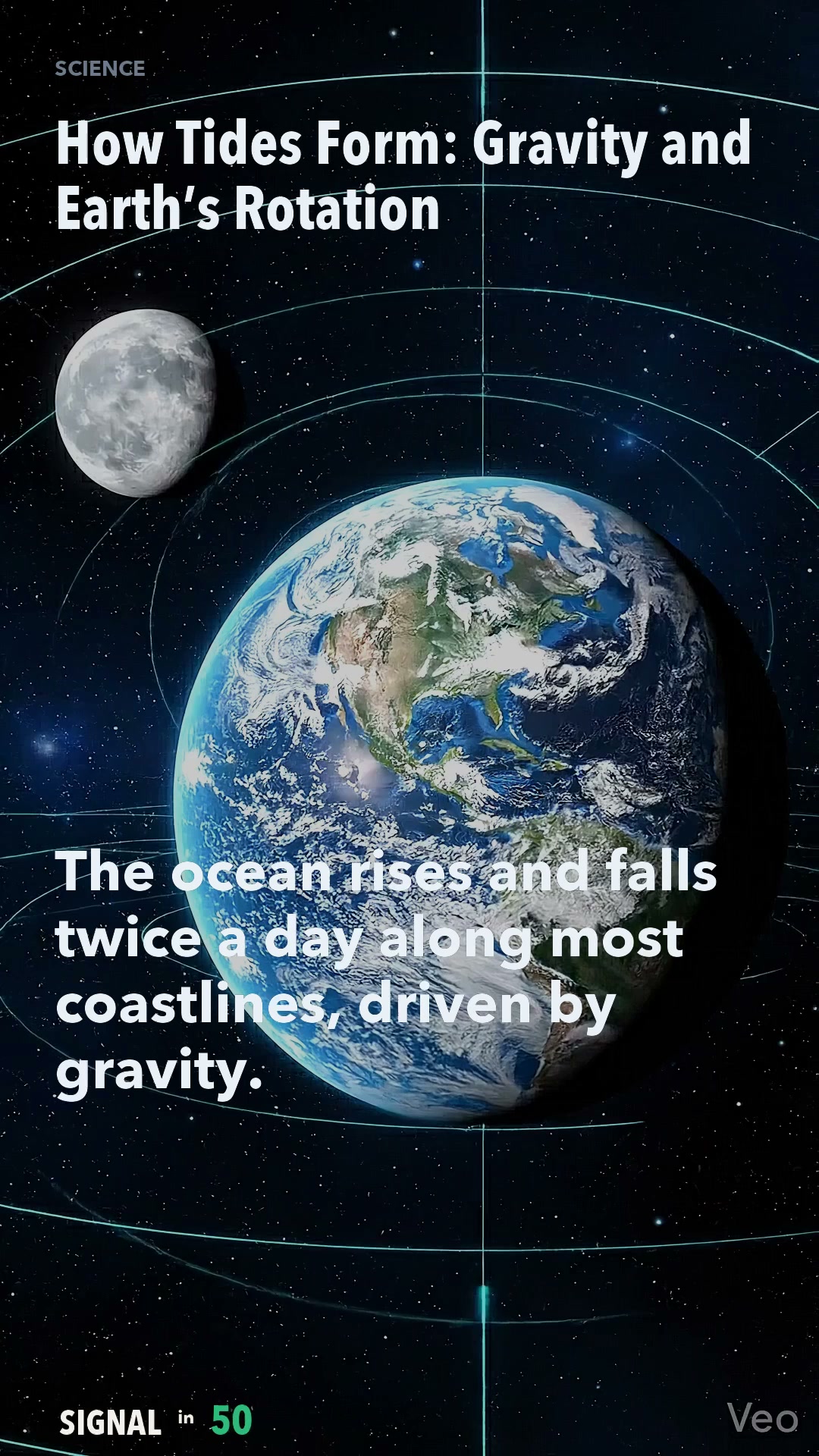
The ocean rises and falls twice a day along most coastlines, driven by gravity. The Moon pulls seawater toward it, creating a bulge on the near side of Earth. A second bulge forms on the far side because Earth itself is pulled slightly away from the water behind it.
The Sun contributes its own pull. When Sun and Moon align during new and full moons, their combined force creates stronger spring tides. When they pull at right angles during quarter moons, weaker neap tides result.
As Earth rotates beneath these two bulges, each coastline passes through both high points roughly every twenty four hours. That steady rotation explains why tides follow a predictable daily cycle.
Local geography reshapes timing and height. Narrow bays funnel water higher, while broad continental shelves slow the tidal wave. The Bay of Fundy in Canada channels tides above fifteen meters, showing coastline shape can matter as much as the Moon itself.
Key facts
- The Moon and Sun pull on Earth's oceans.
- Creating two bulges of water.
- As Earth spins beneath them.
- Most coasts see two high and two low tides in about a day.
- With local timing shaped by basin shape and inertia.
Why it matters
How Tides Form: Gravity and Earth’s Rotation. The clearest explanation of how tides form: gravity and earth’s rotation starts with the main mechanism.
The Signal Brief
One sourced idea worth your attention, in your inbox. No noise.