How Photosynthesis Turns Light Into Stored Energy
Wild fact: photosynthesis makes food from light. Inside leaves, chlorophyll grabs sunlight and uses that jolt to split water. The plant keeps the captured energy in tiny chemical packets, while the oxygen drifts away as leftover exhaust.
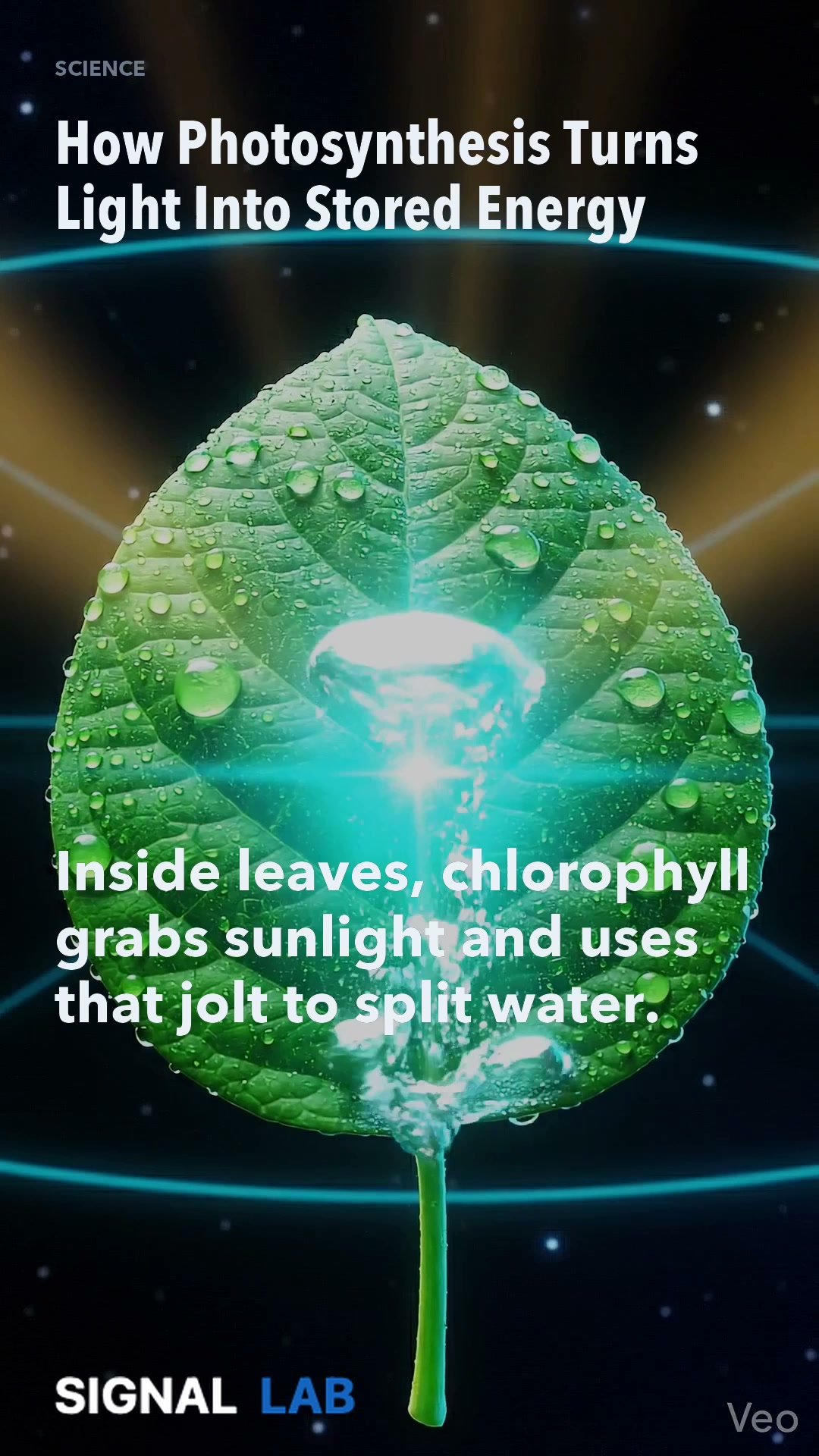
Wild fact: photosynthesis makes food from light. Inside leaves, chlorophyll grabs sunlight and uses that jolt to split water. The plant keeps the captured energy in tiny chemical packets, while the oxygen drifts away as leftover exhaust.
Then comes the hidden second step. Carbon dioxide slips in through tiny pores. An enzyme called RuBisCO catches it, bolts it onto a small sugar, and the leaf keeps rearranging those pieces into more useful carbon building blocks.
After enough turns, those pieces combine into glucose, a sugar packed with stored energy. Plants spend it on cellulose for structure, stash it as starch, and use it to keep growing. Light has become matter the plant can bank.
That is why photosynthesis matters so much. It helps fill the air with oxygen and starts almost every food chain. So when you eat, you are borrowing sunlight, captured by a leaf and locked into sugar first.
Key facts
- Photosynthesis works as a two-stage energy conversion system: capture light energy.
- Then spend that chemical energy to build sugar from carbon dioxide.
- Very strong evergreen educational demand: Amoeba Sisters at 5.7M.
- TED-Ed’s Calvin cycle video at 3.3M.
- Multiple explainers above 1M.
Why it matters
The draft improves on textbook framing by simplifying the process into capture energy. Which has high usefulness and clean four-scene visual logic.
The Signal Brief
One sourced idea worth your attention, in your inbox. No noise.