How Lightning Really Strikes: Step Leaders and Return Strokes
Lightning doesn't strike the way it looks. Inside storm clouds, colliding ice crystals and water droplets separate electric charge, building tens of millions of volts between cloud and ground. That charge imbalance is what triggers the entire sequence.
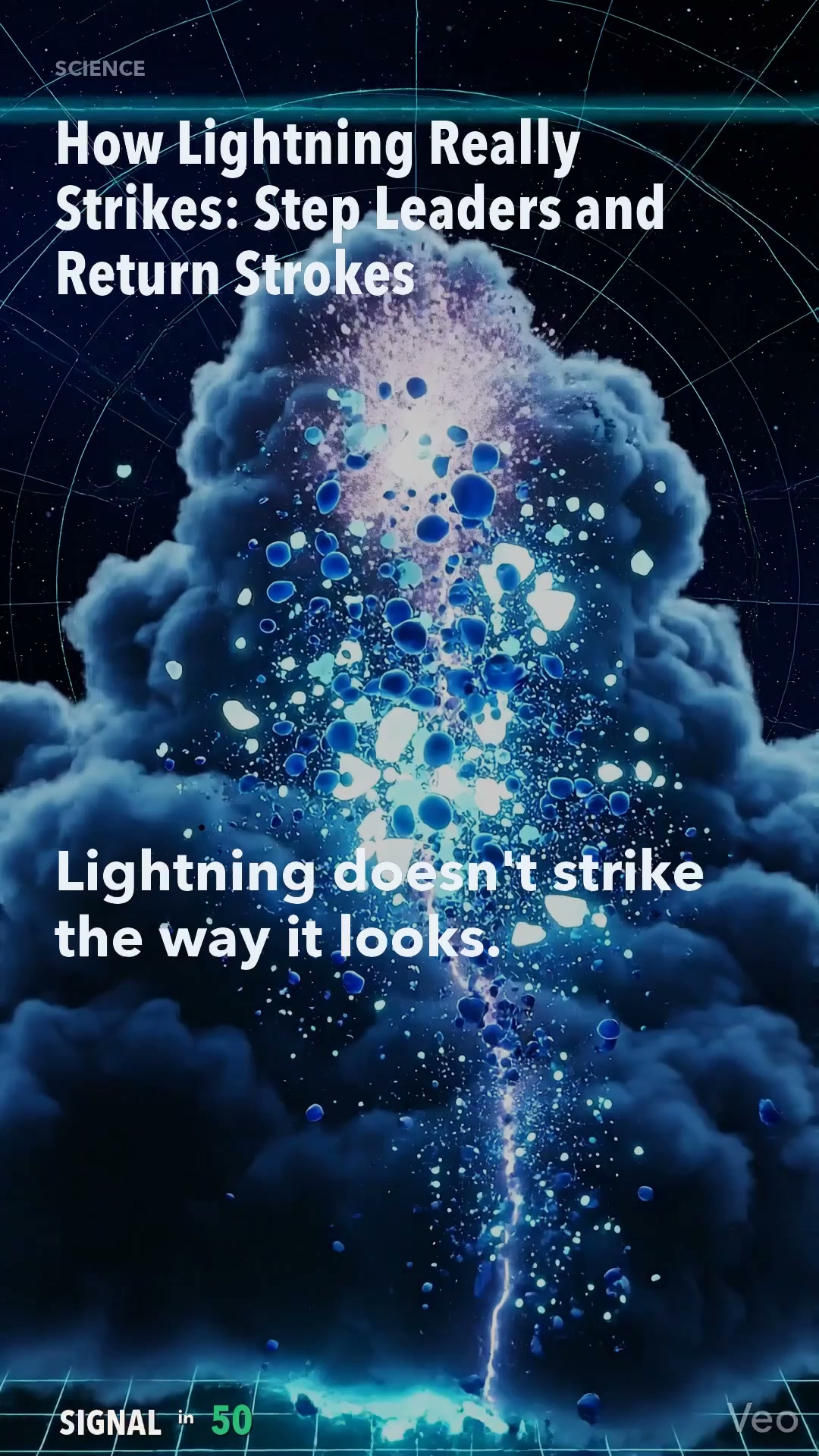
Lightning doesn't strike the way it looks. Inside storm clouds, colliding ice crystals and water droplets separate electric charge, building tens of millions of volts between cloud and ground. That charge imbalance is what triggers the entire sequence.
An invisible channel called a stepped leader crawls downward in jagged fifty-meter jumps, each pause lasting about a microsecond. It ionizes air along its path, carving a conductive thread through what is normally an insulator.
When the leader nears the ground, positive streamers rise from tall objects to meet it. The instant they connect, a return stroke explodes upward at one hundred thousand kilometers per second. That is the blinding flash, heating air to thirty thousand degrees.
That superheated air expands faster than sound, producing thunder. A single strike often contains three to five return strokes in quick succession, which is why lightning flickers. Lightning rods exploit this, offering a preferred path that guides energy safely to ground.
Key facts
- Inside storm clouds, charge separation builds strong electric fields; a stepped leader crawls downward in jumps, then a bright return stroke blasts upward through its ionized path, heating air so fast it glows white-hot.
- How Lightning Really Strikes: Step Leaders and Return Strokes.
- This topic has strong information density and compresses into a useful science explainer.
- This matters because Inside storm clouds, charge separation builds strong electric fields; a stepped leader crawls downward in jumps, then a bright return stroke blasts upward through its ionized path, heating air so fast it glows white-hot.
- How Lightning Really Strikes: Step Leaders and Return Strokes can be explained through the setup, the hidden mechanism, the misconception, and the consequence.
Why it matters
This science topic works well because viewers can learn the core answer in one concise sequence. Signal50 should keep the explanation factual, source-grounded, and visually clear from the first scene to the last.
The Signal Brief
One sourced idea worth your attention, in your inbox. No noise.