Peristalsis: The Muscle Wave That Moves Food Without Gravity
Wait, gravity is optional. Peristalsis, the muscle wave that moves food, lets you swallow upside down because your esophagus squeezes the bite forward instead of letting it simply fall. The trick is your gut’s own control network.
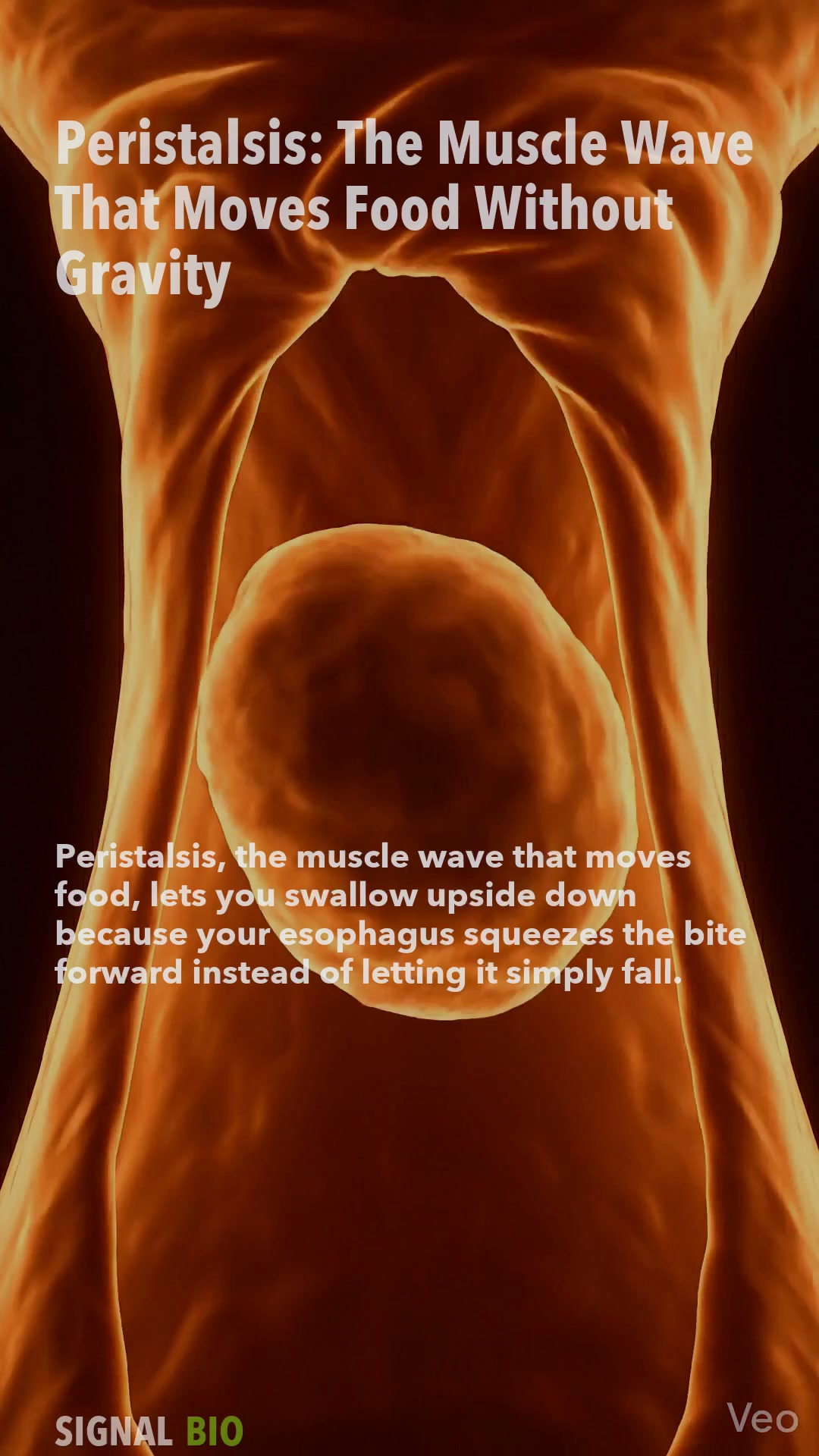
You can swallow food standing on your head. That's because your gut doesn't rely on gravity — it has its own nervous system. Five hundred million neurons line your digestive tract, forming what physiologists call the 'second brain.' These neurons coordinate a precise wave called peristalsis: a ring of circular muscle contracts behind the food bolus while longitudinal muscle ahead relaxes, creating a squeeze that propels everything forward. The timing comes from pacemaker cells called interstitial cells of Cajal, which fire rhythmic slow waves three to twelve times per minute depending on the region. This system is so autonomous that if you sever every nerve connecting the gut to the brain, peristalsis continues. It's why astronauts on the ISS eat, digest, and absorb nutrients normally — the wave doesn't need gravity. It never did.
Key facts
- The enteric nervous system.
- 500 million neurons operating independently of the brain.
- Drives coordinated smooth-muscle contractions that push food through 9 metres of gut regardless of body position or gravity.
- Highest search demand in batch (0.869).
- Ninja Nerd GI motility at 610K views, enteric nervous system at 411K.
Why it matters
Recent 2025 uploads from Dr Matt & Dr Mike pulling 47-59K views confirm ongoing demand. Physiology is textbook-settled (Guyton, Boron).
The Signal Brief
One sourced idea worth your attention, in your inbox. No noise.