Lactate Threshold: The Physiology of 'The Burn'
The burn is backwards. Lactate threshold is not your muscles dying. It is the moment hard effort makes fuel faster than your body can reuse it, so speed suddenly feels expensive and your breathing spikes.
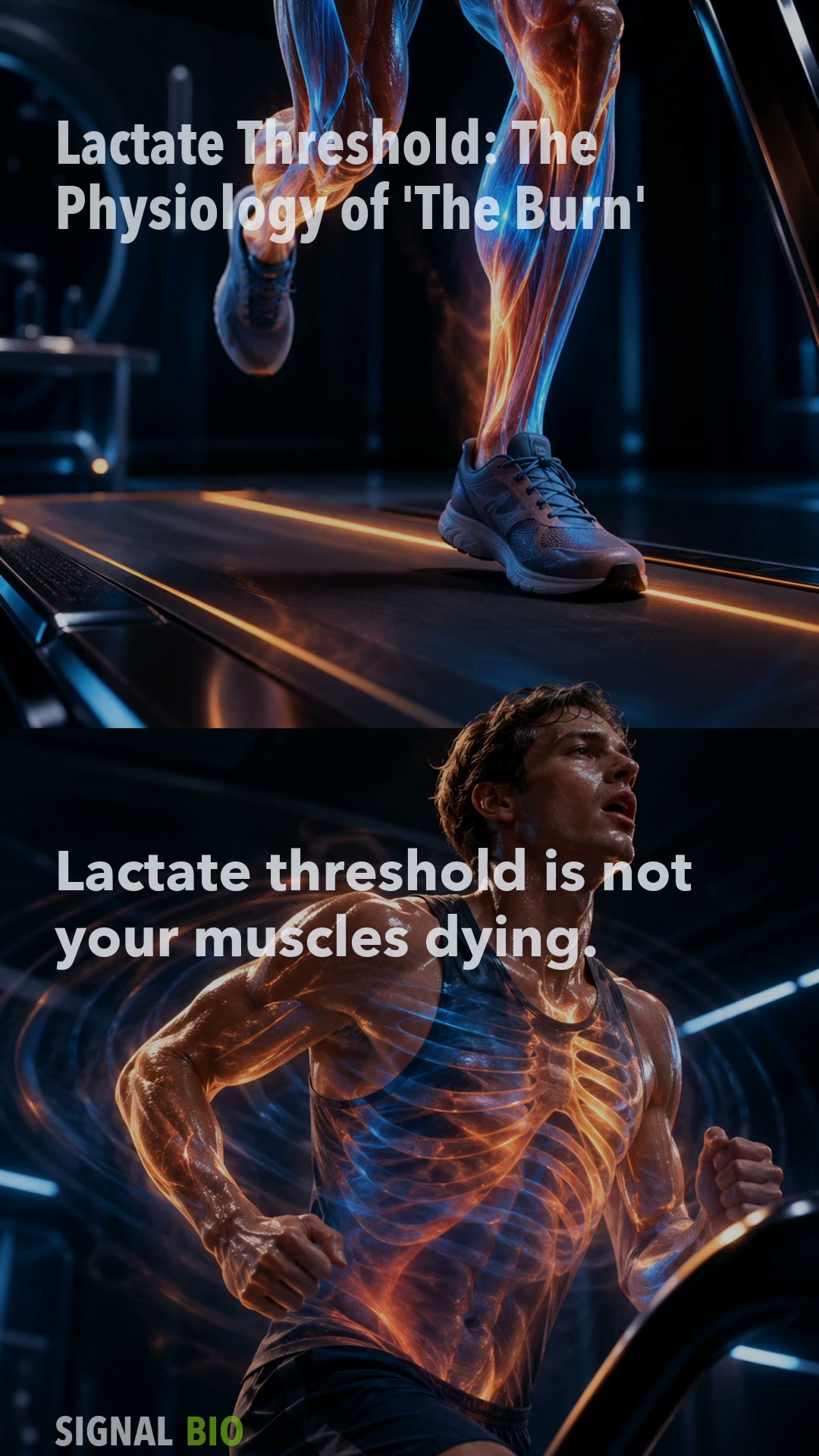
The burn is backwards. Lactate threshold is not your muscles dying. It is the moment hard effort makes fuel faster than your body can reuse it, so speed suddenly feels expensive and your breathing spikes.
Here is the twist. Lactate is not waste. It is usable fuel. Working muscle releases it, nearby cells grab it, and tiny mitochondria, the cell's power plants, can burn it for more energy.
Your real limit is how fast that shuttle works. Fast fibers dump lactate. Mitochondria absorb and burn it. When production beats clearance, lactate piles up, the burn surges, and your pace falls off a cliff.
Training shifts that tipping point. More mitochondria and better clearance let you reuse more lactate before it backs up. So the burn is not proof you are broken. It is proof your recycling system hit capacity.
Key facts
- Explains how the body recycles lactate as a high-octane fuel and how to shift the metabolic tipping point for elite endurance.
- Strong demand for endurance physiology with 110k+ views on top academic results.
- Shift in focus from 'cardio' to 'metabolic clearance' confirmed by search velocity and high-quality source availability.
- That burning sensation in your lungs isn’t muscle failure; it’s a fuel overflow.
- Lactate isn’t metabolic waste—it’s high-octane energy your body hasn’t learned to recycle fast enough.
Why it matters
The limit of your endurance is defined by the 'Lactate Shuttle.' This mechanism moves lactate from your fast-twitch fibers into your mitochondria to be burned as fuel. When you hit your threshold.
The Signal Brief
One sourced idea worth your attention, in your inbox. No noise.