Mantis Shrimp Strike: The Biomechanics of Cavitation - Short Version
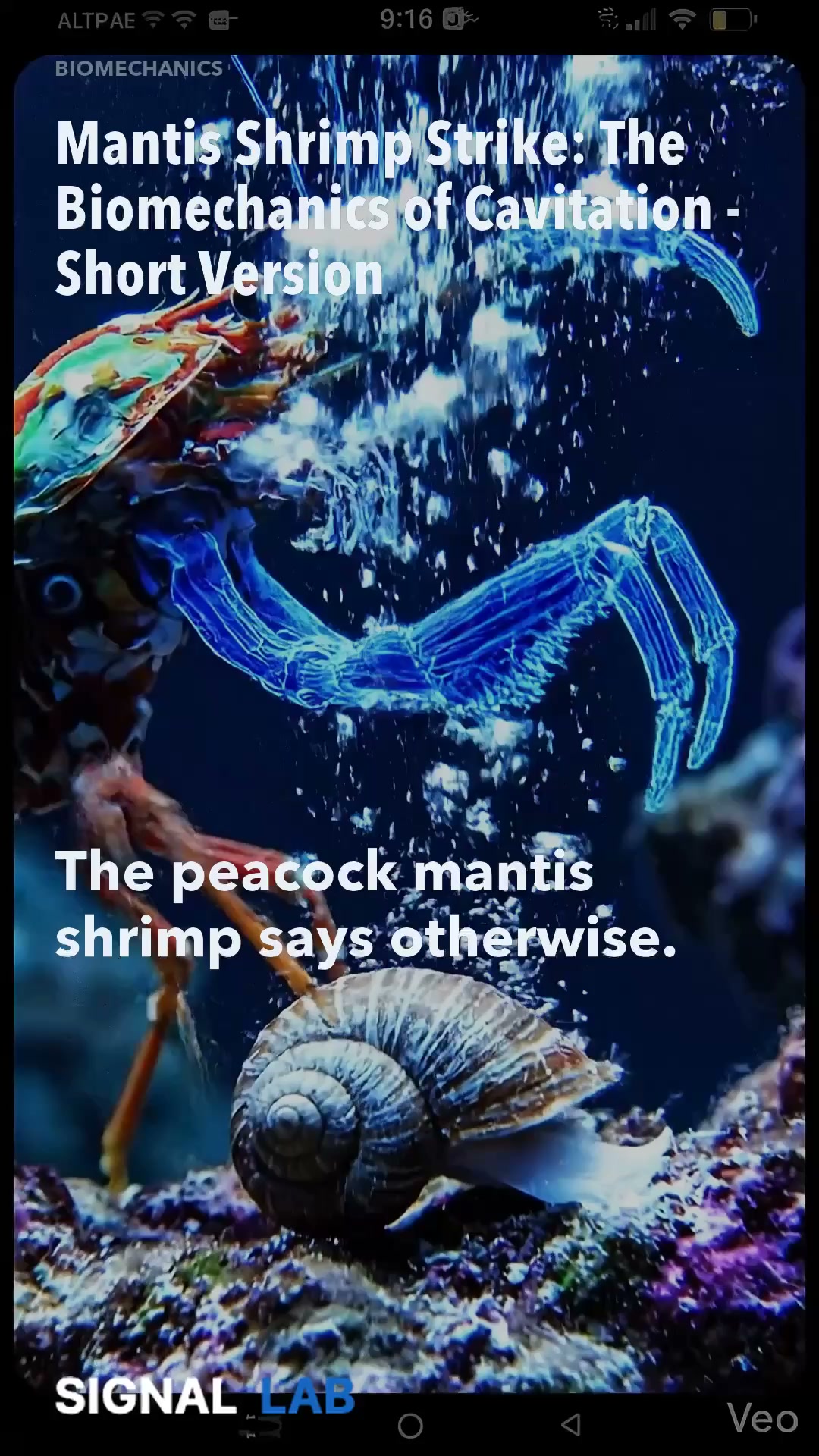
Too small to matter? The peacock mantis shrimp says otherwise. Its club can smash prey, but the stranger question is this: how does a tiny animal hit so fast that water joins the attack?
Too small to matter? The peacock mantis shrimp says otherwise. Its club can smash prey, but the stranger question is this: how does a tiny animal hit so fast that water joins the attack?
That should be impossible. Water fights fast motion hard. It is dense, and drag grabs a swinging limb almost instantly, so muscle alone should never power such a violent underwater punch.
So the shrimp cheats the limit. It loads energy slowly into a stiff spring built into its shell, while a latch locks the limb back. Release that latch, and the club snaps forward faster than muscle can.
That burst also drops pressure so sharply that vapor bubbles appear and collapse. The prey is hit twice: first by the club, then by imploding bubbles. The lesson is wild and simple: it weaponizes water, not just muscle.
Key facts
- A peacock mantis shrimp can hit hard enough to break prey with a blow that seems too violent for an animal this small.
- The real question is not just how it swings its club.
- But how that strike moves so fast that the water itself turns against the target.
- But how that strike moves.
- Fast that the water itself turns against the target.
Why it matters
That matters because water is supposed to slow fast motion down. So any limb trying to punch through it faces drag almost immediately.
The Signal Brief
One sourced idea worth your attention, in your inbox. No noise.