Van Gogh's Wheatfield with Crows - The Landscape With No Safe Exit
Wait, why does Wheatfield with Crows feel trapped? Van Gogh makes open land feel shut. Three paths split, none clearly escape.
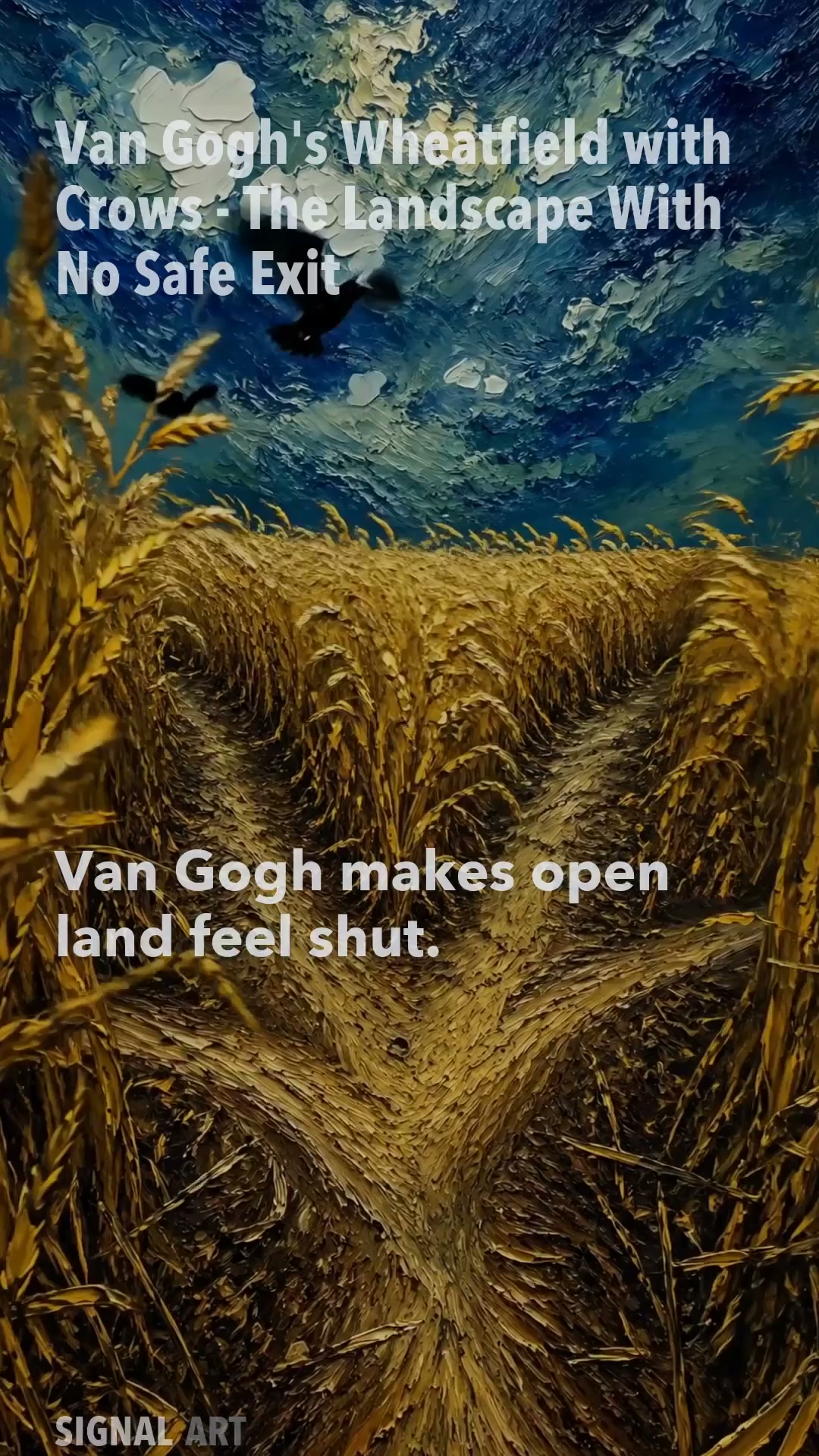
Wait, why does Wheatfield with Crows feel trapped? Van Gogh makes open land feel shut. Three paths split, none clearly escape. Yellow grain surges forward while black crows slash a bruised blue sky.
That tension is built, not imagined. The horizon sits high and tight. Heavy brushstrokes thicken the field. Hard jumps between yellow, blue, and black kill any calm, so distance feels closer and pressure rises.
Then the context sharpens it. In 1890, near Auvers-sur-Oise, Van Gogh kept painting wheat fields in his final weeks. This one is not a diary entry. It is a visual machine for unease.
That is why the painting still lands. It does not show danger directly. It makes seeing itself feel cornered. The field is outside, but the suspense happens inside you, which is the real trap.
Key facts
- Wheatfield with Crows was made by Vincent van Gogh.
- The work is associated with 1890 and Post-Impressionist.
- A major version or holding is associated with Van Gogh Museum.
- The compressed horizon, heavy brushwork, and abrupt color contrasts make open country feel tense rather than peaceful.
- Van Gogh painted several intense wheatfield works near Auvers-sur-Oise in the final weeks of his life.
Why it matters
It matters because landscape becomes psychological suspense: the field is outside, but the drama is internal.
The Signal Brief
One sourced idea worth your attention, in your inbox. No noise.