Van Gogh's Irises - The Garden That Became A Nervous System
Van Gogh's Irises looks floral, but its power is pressure after rain. Each leaf bends like a nervous line, and the garden becomes a system of forces rather than a calm bouquet. The color is not decorative.
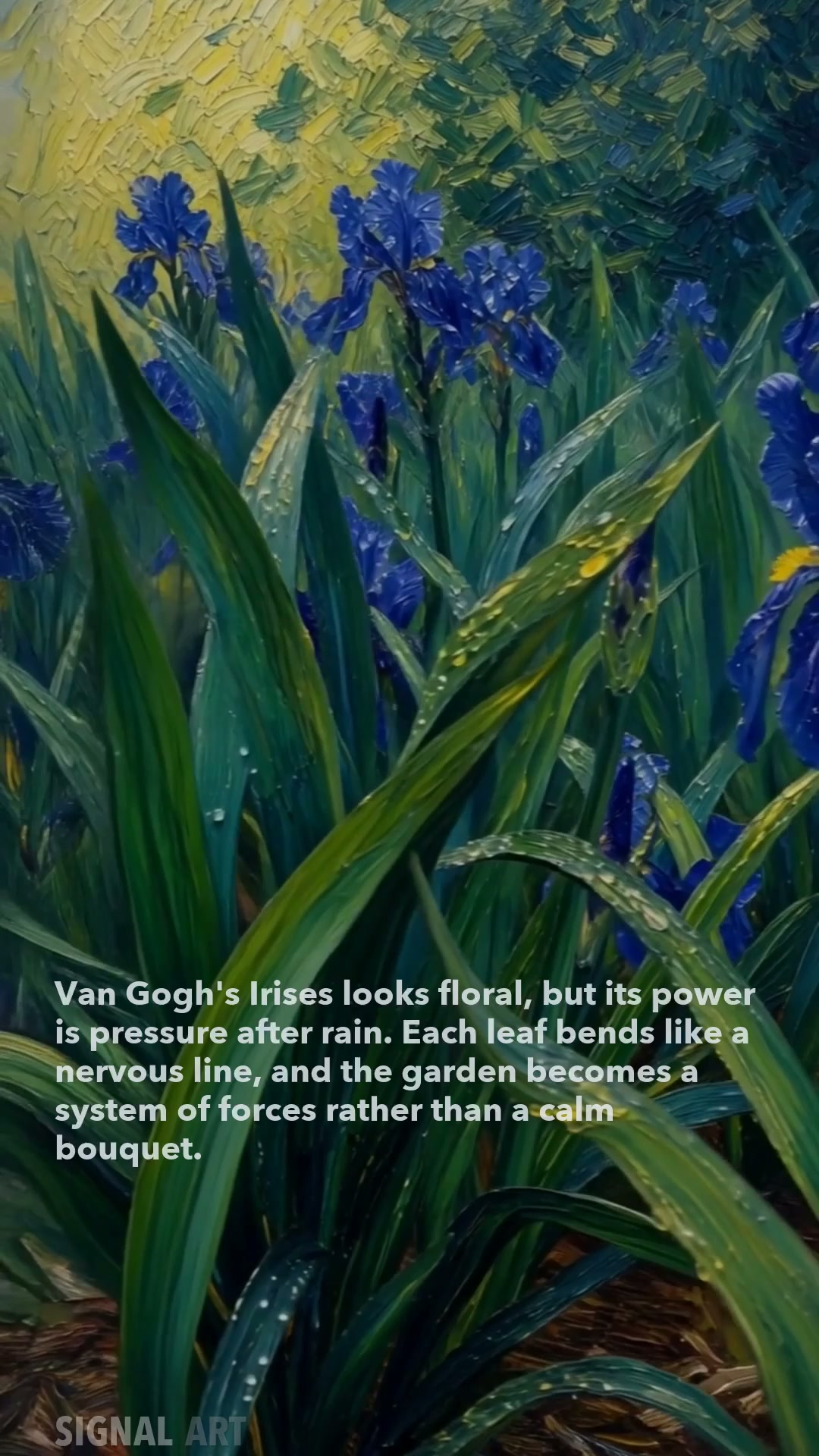
Van Gogh's Irises looks floral, but its power is pressure after rain. Each leaf bends like a nervous line, and the garden becomes a system of forces rather than a calm bouquet.
The color is not decorative. Blue flowers, green blades, and one pale bloom create a rhythm of difference against silence, as if individuality is pushing through a crowd of living marks.
Painted at Saint-Remy in 1889, the work often gets softened into beauty. But its real subject is attention under strain made visible: nature seen with urgency, not distance.
That is why it stays vivid. Irises turns a flower bed into a mind in motion, where every curve asks whether order is healing the viewer or barely holding, like breath held in color.
Key facts
- Irises was made by Vincent van Gogh.
- The work is associated with 1889 and Post-Impressionist.
- A major version or holding is associated with J. Paul Getty Museum.
- Van Gogh uses cropped space, sharp contours, and blue-violet against green to make pattern feel alive instead of decorative.
- He painted Irises soon after entering the asylum at Saint-Remy, studying the garden with intense attention.
Why it matters
The result matters because it makes observation feel urgent: nature is not background, it is a field of energy.
The Signal Brief
One sourced idea worth your attention, in your inbox. No noise.