Turner's Rain, Steam and Speed - The Train That Dissolved The Landscape
Wait, a train became weather? In Turner’s Rain, Steam and Speed, the engine is there, but it almost melts into rain, smoke, bridge, river, and light. Industry does not enter the landscape.
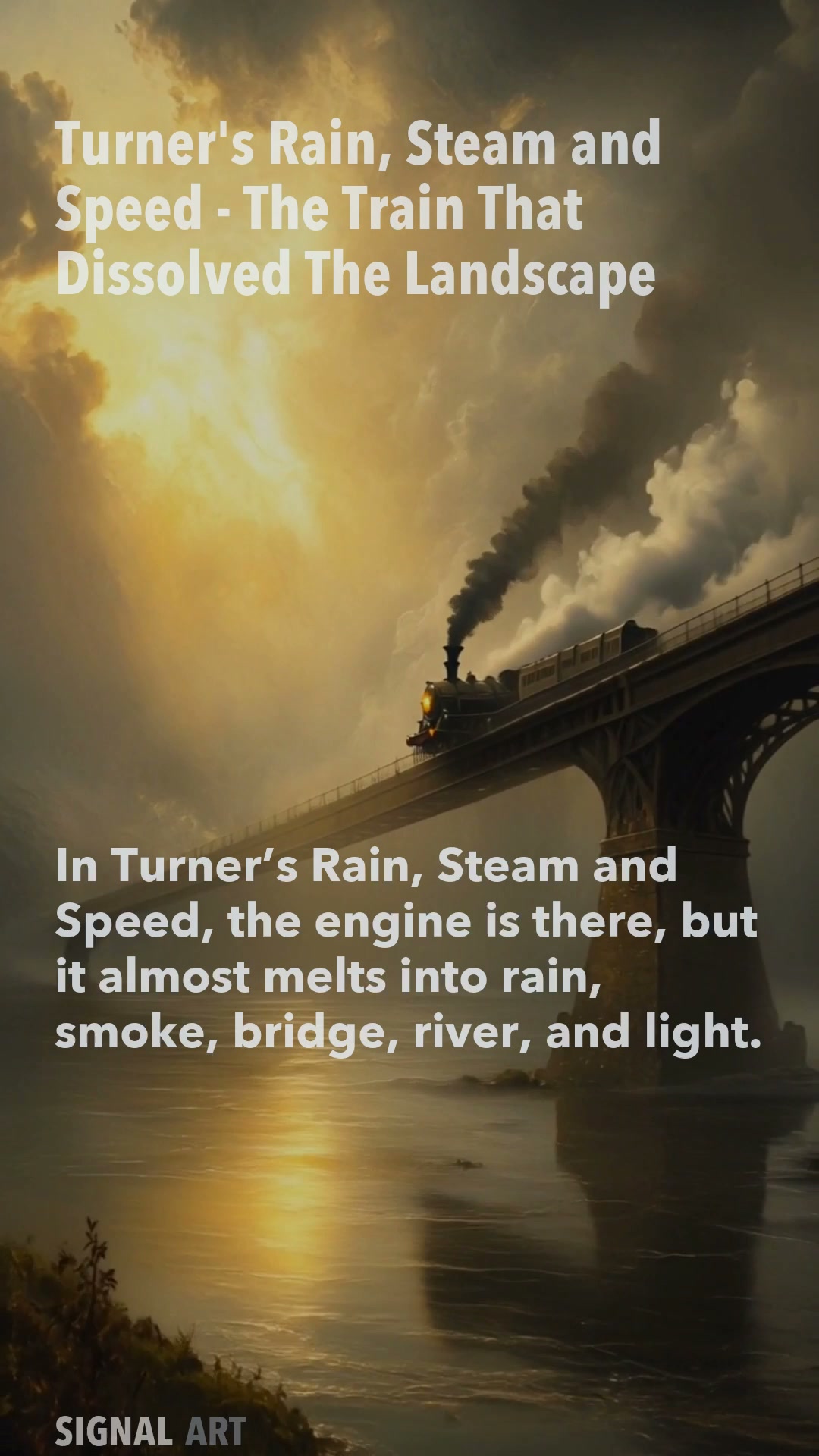
Wait, a train became weather? In Turner’s Rain, Steam and Speed, the engine is there, but it almost melts into rain, smoke, bridge, river, and light. Industry does not enter the landscape. It devours it.
That blur is the point. Turner uses loose brushwork, wet haze, and a hard diagonal bridge so your eye rushes forward. You do not inspect the machine calmly. You feel speed before photography could pin it still.
In 1844, that feeling was new. Railways were remaking distance, and the Great Western line stood for that shock. Turner did not paint a neat machine portrait. He painted what modern travel did to human perception.
That is why the painting still matters. Modern technology becomes sublime here not through precision, but through overload. Turner shows the machine changing vision itself, which is why this image feels strangely contemporary instead of merely old.
Key facts
- Rain, Steam and Speed was made by J. M. W. Turner.
- The work is associated with 1844 and Romantic landscape.
- A major version or holding is associated with National Gallery, London.
- Loose brushwork, vaporous atmosphere, and diagonal motion make speed feel visible before photography could truly freeze it.
- Painted in 1844, it responds to the railway age and the Great Western Railway.
Why it matters
It matters because modern technology becomes sublime, not by precision, but by overwhelming perception.
The Signal Brief
One sourced idea worth your attention, in your inbox. No noise.