The Persistence of Memory - When Time Melts
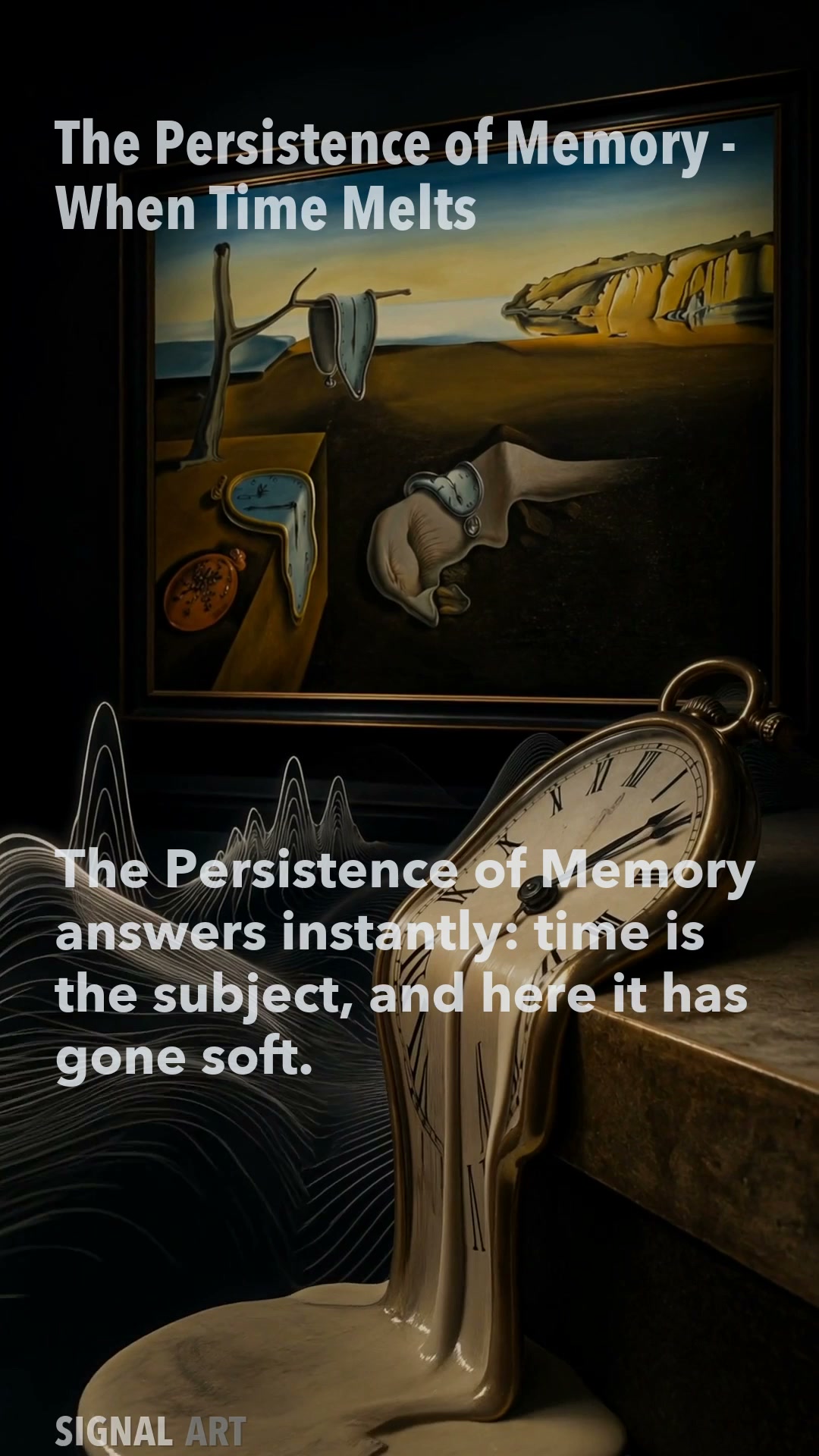
Why do Dali’s clocks melt? The Persistence of Memory answers instantly: time is the subject, and here it has gone soft. In this tiny 1931 painting, a still shoreline holds sagging watches like metal forgetting its own rules.
Why do Dali’s clocks melt? The Persistence of Memory answers instantly: time is the subject, and here it has gone soft. In this tiny 1931 painting, a still shoreline holds sagging watches like metal forgetting its own rules.
The trick is realism. The horizon stays steady. The shadows stay sharp. Stone, branch, sea, and light all look exact. Because the world behaves, the impossible watches feel less like fantasy and more like perception quietly breaking.
So these clocks are not about machinery. They turn measurement into feeling: waiting, dreaming, grief, boredom, memory. In the mind, time stretches, collapses, and drifts. Dali gives that slippery inner experience one clean, unforgettable shape.
That is why this tiny image grew huge in culture. It does not just show a strange dream. It teaches something tougher: reality can look stable while the mind reshapes it underneath. Once you see that, those drooping clocks feel precise, not silly.
Key facts
- Salvador Dali painted The Persistence of Memory in 1931, making it one of the most famous images of Surrealism.
- The painting places soft, melting clocks in a sharply rendered landscape, combining realistic technique with impossible objects.
- The limp clocks turn time from a fixed measurement into something unstable, dreamlike, and psychological.
- The small scale of the painting contrasts with its enormous cultural impact as an image of distorted time.
- Dali's hard-edged realism makes the impossible scene feel more convincing than a loose fantasy would.
Why it matters
The painting matters because it gives a simple visual form to memory, dream logic, and the feeling that time can stretch or collapse in the mind.
The Signal Brief
One sourced idea worth your attention, in your inbox. No noise.