The Great Wave - The Image That Became Motion
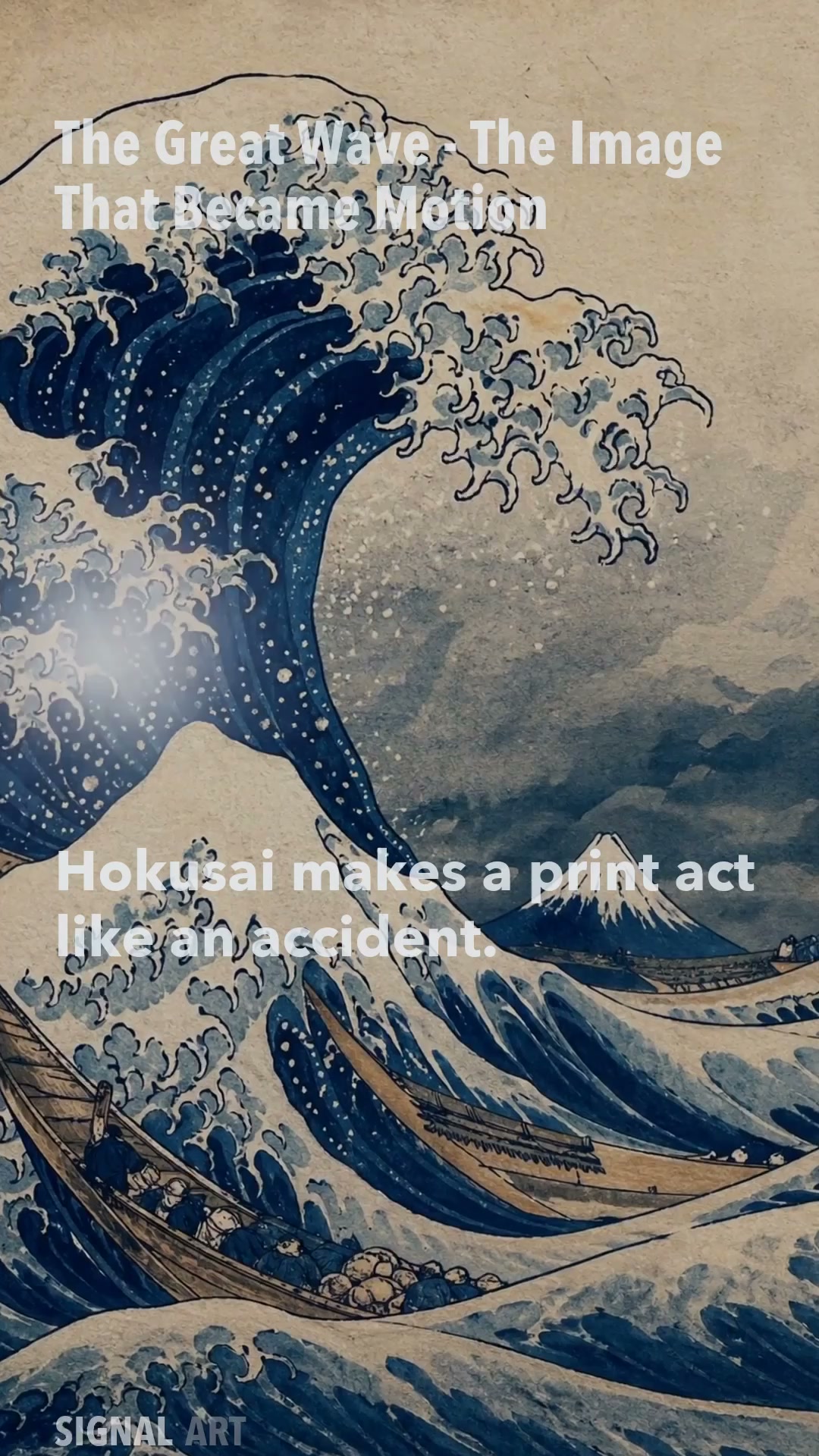
Why does The Great Wave move? Hokusai makes a print act like an accident. Around 1830, sea, boats, and Mount Fuji lock into one split second, so a still picture hits like action.
Why does The Great Wave move? Hokusai makes a print act like an accident. Around 1830, sea, boats, and Mount Fuji lock into one split second, so a still picture hits like action.
The trick starts with scale. Mount Fuji should dominate, but Hokusai shrinks it into calm distance while the wave towers overhead. The mountain feels fixed. The water suddenly steals the job of permanence.
Then comes the snap. The curve drags your eye forward, foam splits into clawlike fingers, and the boats lean inside the arc. Nothing moves, yet every line stores momentum and points toward collapse.
That is why it still feels modern. Prussian blue deepens the shock, and the whole design compresses danger into one clean silhouette. The Great Wave is not just a landscape. It teaches you how pictures move.
Key facts
- Katsushika Hokusai made The Great Wave off Kanagawa around 1830 to 1832 as part of the Thirty-Six Views of Mount Fuji series.
- The composition makes Mount Fuji small and distant while the wave dominates the foreground above boats and rowers.
- The wave's curved form and claw-like foam create a sense of motion even though the print freezes a single instant.
- The print uses Prussian blue, a synthetic pigment that helped give the image its striking depth and cool intensity.
- The Great Wave became globally recognizable partly because its design compresses danger, nature, and rhythm into one simple silhouette.
Why it matters
The image matters because it turns landscape into pure visual motion, making nature feel both beautiful and overwhelming.
The Signal Brief
One sourced idea worth your attention, in your inbox. No noise.