The Birth of Venus - Beauty As Power
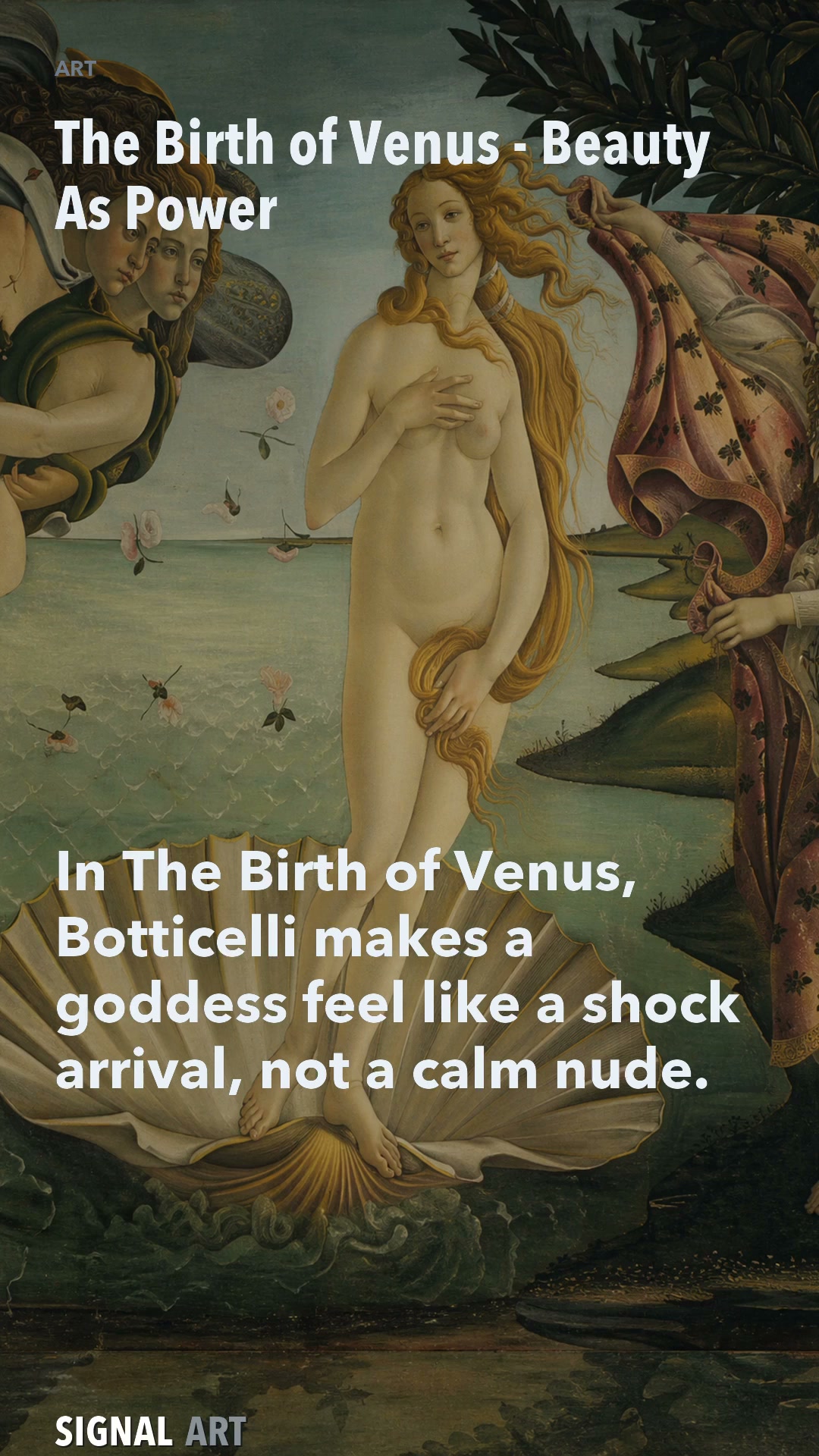
Beautiful, but wrong on purpose. In The Birth of Venus, Botticelli makes a goddess feel like a shock arrival, not a calm nude. The whole scene bends toward her, so beauty already acts like power.
Beautiful, but wrong on purpose. In The Birth of Venus, Botticelli makes a goddess feel like a shock arrival, not a calm nude. The whole scene bends toward her, so beauty already acts like power.
Then the trick appears. Her neck stretches. Her stance should collapse. The body ignores ordinary anatomy because Botticelli is not painting a person. He is building an ideal, polished until it feels almost untouchable.
That mattered in Renaissance Florence. Myth, poetry, Christian ideas, and elite patronage all meet here. Venus becomes more than a body. She signals intellect, status, and cultivated taste, turning beauty into a social language.
So the painting still lands because every wind, glance, and fold stages her arrival. Botticelli does not just show beauty. He organizes belief around it, and that makes you notice how images teach power.
Key facts
- Sandro Botticelli painted The Birth of Venus in the late fifteenth century, showing Venus arriving on a shell after her mythic birth from the sea.
- The figure of Venus is idealized rather than anatomically natural, with an elongated neck, stylized posture, and symbolic grace.
- The painting draws on classical mythology within Renaissance Florence, where ancient subjects could carry poetic, intellectual, and elite cultural meaning.
- The wind gods at the left and the attendant at the right turn Venus's arrival into a staged visual event.
- The painting is on canvas rather than panel, which was less typical for large Florentine paintings of its period.
Why it matters
The painting matters because it presents beauty not as simple decoration, but as a powerful cultural ideal shaped by myth, patronage, and design.
The Signal Brief
One sourced idea worth your attention, in your inbox. No noise.