Starry Night - The Sky That Moves
Wait, Starry Night is not calm. Van Gogh's 1889 night looks quiet at first: village below, cypress rising, stars glowing. Then the shock lands.
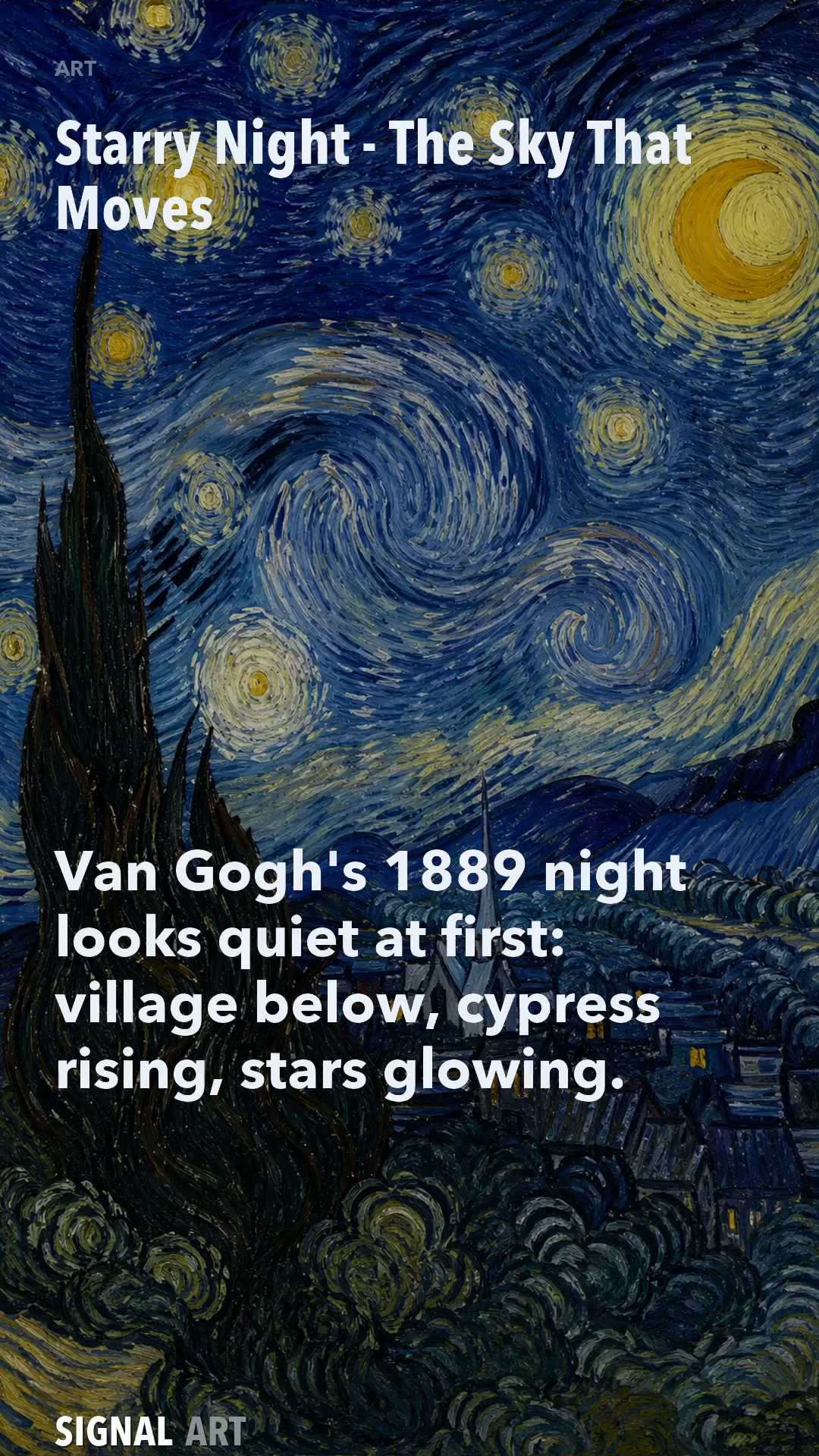
Wait, Starry Night is not calm. Van Gogh's 1889 night looks quiet at first: village below, cypress rising, stars glowing. Then the shock lands. The whole sky seems to move, as if darkness itself has currents.
That feeling is built, not borrowed from nature. Van Gogh bends the air with curved brushstrokes. Blue arcs push against yellow halos. The stars do not just shine. They pulse, and the paint makes you feel it.
It gets deeper. He painted it in Saint-Remy during a brutal period, so the view is never pure observation. It is seen, remembered, and transformed. The landscape becomes a pressure chamber where feeling hardens into shape.
That is why the painting still hits. It makes inner experience visible without putting a person in the center. Once you notice the sky as motion, modern art clicks: landscape stops describing the world and starts revealing a mind.
Key facts
- The Starry Night was painted by Vincent van Gogh in 1889.
- The painting shows a village, a cypress tree, stars, moon, and a highly stylized moving sky.
- Van Gogh painted it during his period at Saint-Remy, when his work often transformed observed landscapes through imagination and emotion.
- The sky's motion is created largely through curved, directional brushstrokes rather than realistic atmospheric detail.
- The painting's fame comes partly from how clearly it visualizes emotional intensity without a human figure at the center.
Why it matters
The Starry Night matters because it made inner experience visible through landscape, helping define modern art's move away from literal description.
The Signal Brief
One sourced idea worth your attention, in your inbox. No noise.