Monet's Water Lilies - The Pond That Swallowed The Horizon
Monet's Water Lilies can look peaceful until you notice the trick: there is no horizon to rescue you from below. The pond becomes a whole world, and the viewer is placed inside reflection. The brushwork keeps dissolving edges.
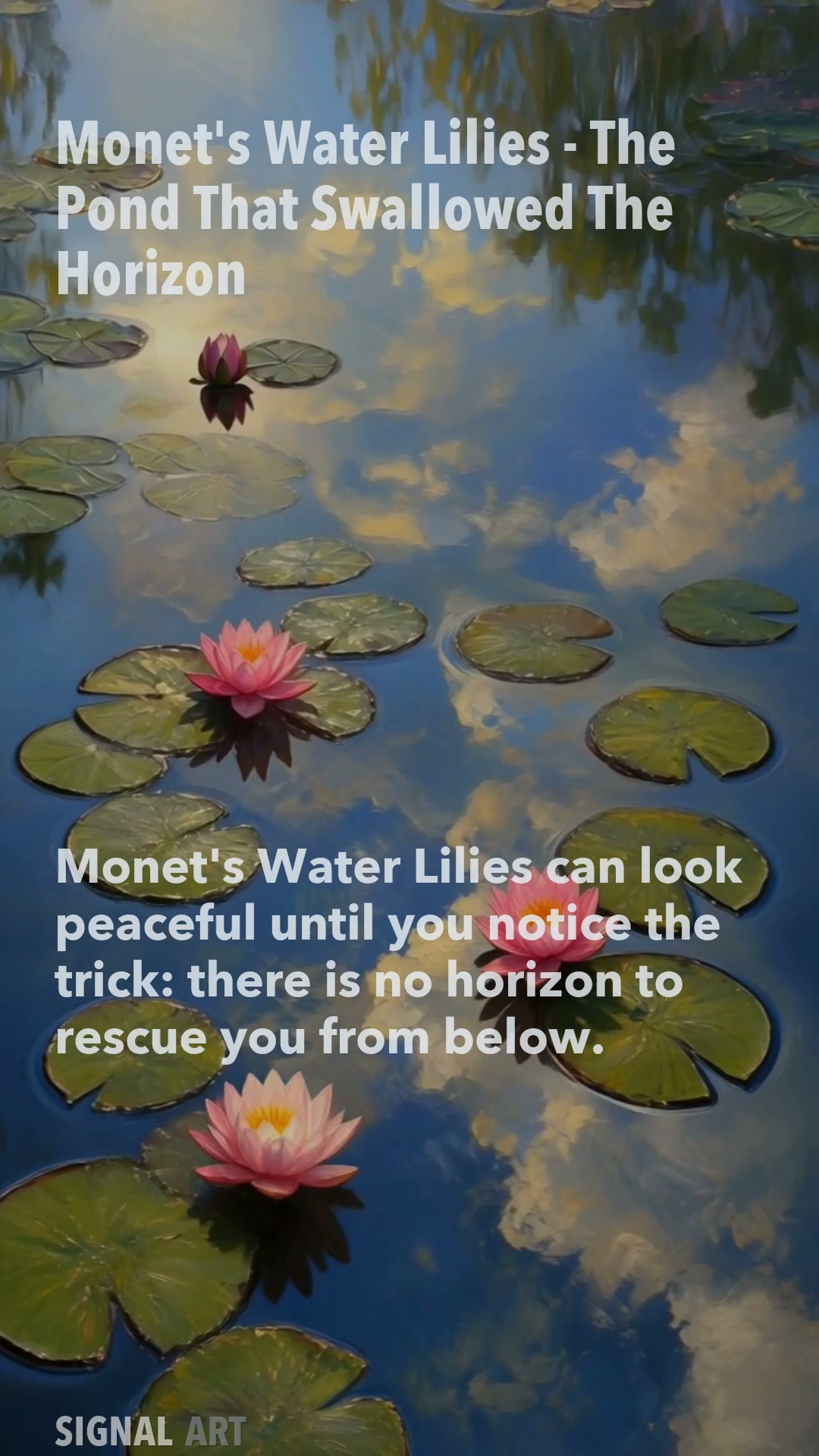
Monet's Water Lilies can look peaceful until you notice the trick: there is no horizon to rescue you from below. The pond becomes a whole world, and the viewer is placed inside reflection.
The brushwork keeps dissolving edges. Leaves, clouds, water, and sky trade places at once, so depth stops behaving. Monet is not painting scenery; he is painting perception losing its frame.
That mattered late in his life, when the garden at Giverny became a laboratory for sustained looking. Repetition turns the same pond into time, weather, memory, and doubt.
The missed point is not softness. Water Lilies is radical because it removes stable ground. You do not look across a landscape; you drift inside an image that will not settle. That is the quiet shock.
Key facts
- Water Lilies was made by Claude Monet.
- The work is associated with 1890s-1920s and Late Impressionism.
- A major version or holding is associated with Musee de l’Orangerie and many collections.
- Layered color, floating forms, and broken reflections make the viewer lose track of depth and sky.
- Monet painted the lily pond at Giverny for decades, especially in large late panels.
Why it matters
The series matters because it pushes landscape toward abstraction while still feeling rooted in weather and light.
The Signal Brief
One sourced idea worth your attention, in your inbox. No noise.