Claude Monet: Hardship, Light, and the Reinvention of Painting
Monet nearly vanished. In 1868, broke and evicted, Claude Monet jumped into the Seine and survived. That jolt matters, because the soft, glowing paintings people treat as calm were forged inside panic, hunger, and risk.
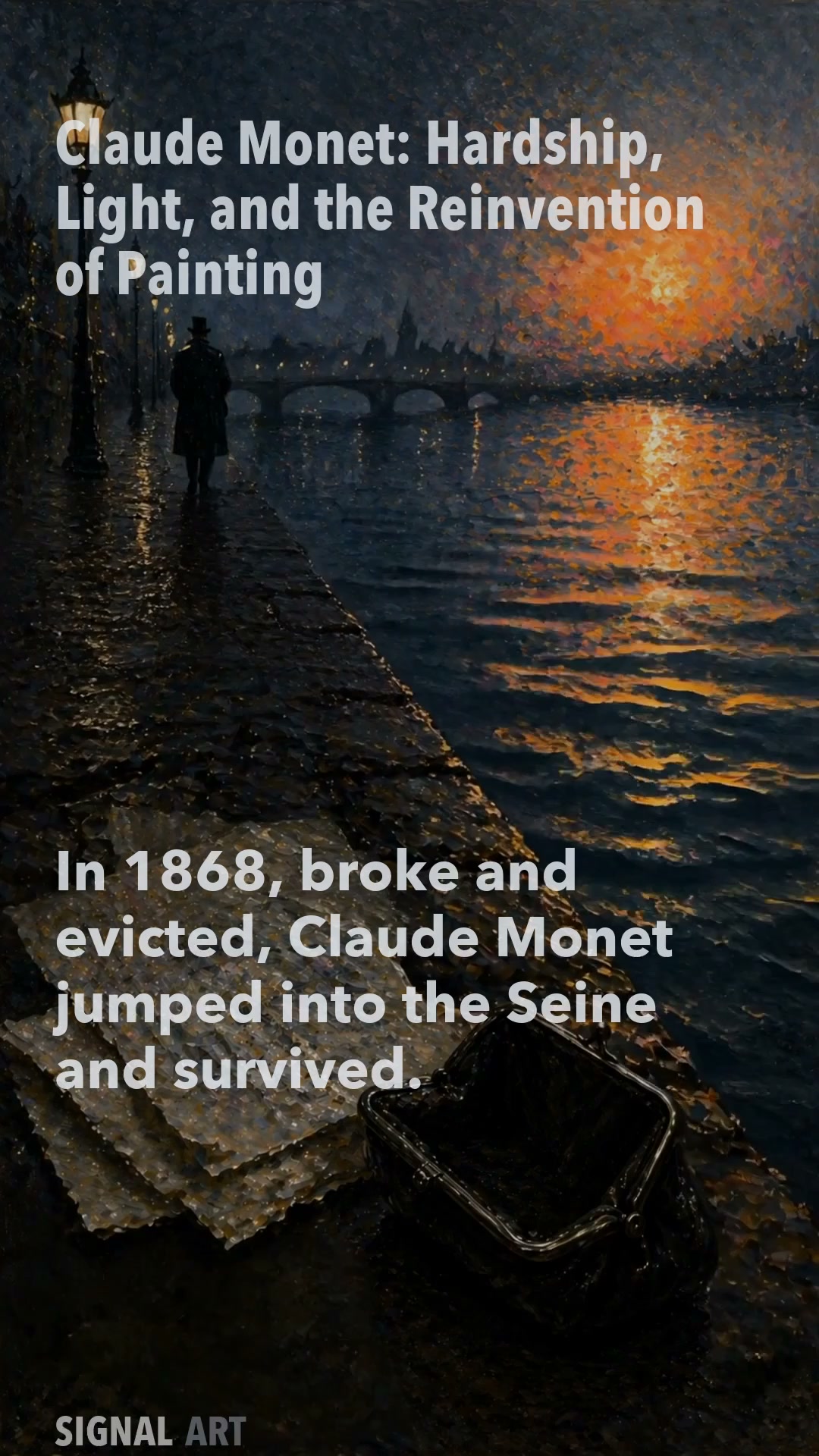
Monet nearly vanished. In 1868, broke and evicted, Claude Monet jumped into the Seine and survived. That jolt matters, because the soft, glowing paintings people treat as calm were forged inside panic, hunger, and risk.
He trained his eye on change. In Le Havre, Boudin pushed him outdoors, where sea, sky, weather, and fast light mattered more than polished outlines. Paris, Algeria, and forest studies taught him to chase what flickers before it settles.
Success dragged. A green-dress portrait sold, larger works failed, and war sent him to London. There, fog, water, and dawn haze loosened form. Impression, Sunrise did not finish a scene. It caught atmosphere before the world fully appeared.
That is why Giverny changed painting. Haystacks, cathedrals, and water lilies became repeat experiments in hour, season, weather, even cataract-blurred color. Monet’s big idea was not one masterpiece. It was this: painting could record seeing as it happens.
Key facts
- Claude Monet was born in Paris in 1840 and moved to Le Havre at age five.
- In 1868, during extreme financial distress, Monet jumped into the Seine and survived.
- Eugène Boudin encouraged Monet to paint outdoors and helped shape his attention to sea, sky, and light.
- Monet’s unfinished Luncheon on the Grass was cut into sections to help settle debts.
- At the first Impressionist exhibition in 1874, Monet exhibited 12 paintings.
Why it matters
Monet helped redefine painting around direct perception, transient light, and atmosphere rather than polished academic convention.
The Signal Brief
One sourced idea worth your attention, in your inbox. No noise.