Bosch's The Garden of Earthly Delights - The Triptych That Looks Like A Dream Interface
Wait, Bosch's Garden of Earthly Delights feels less like a sermon than a screen opening. Paradise, pleasure, and punishment appear together, so the eye must choose its path before judgment begins. The shock is density.
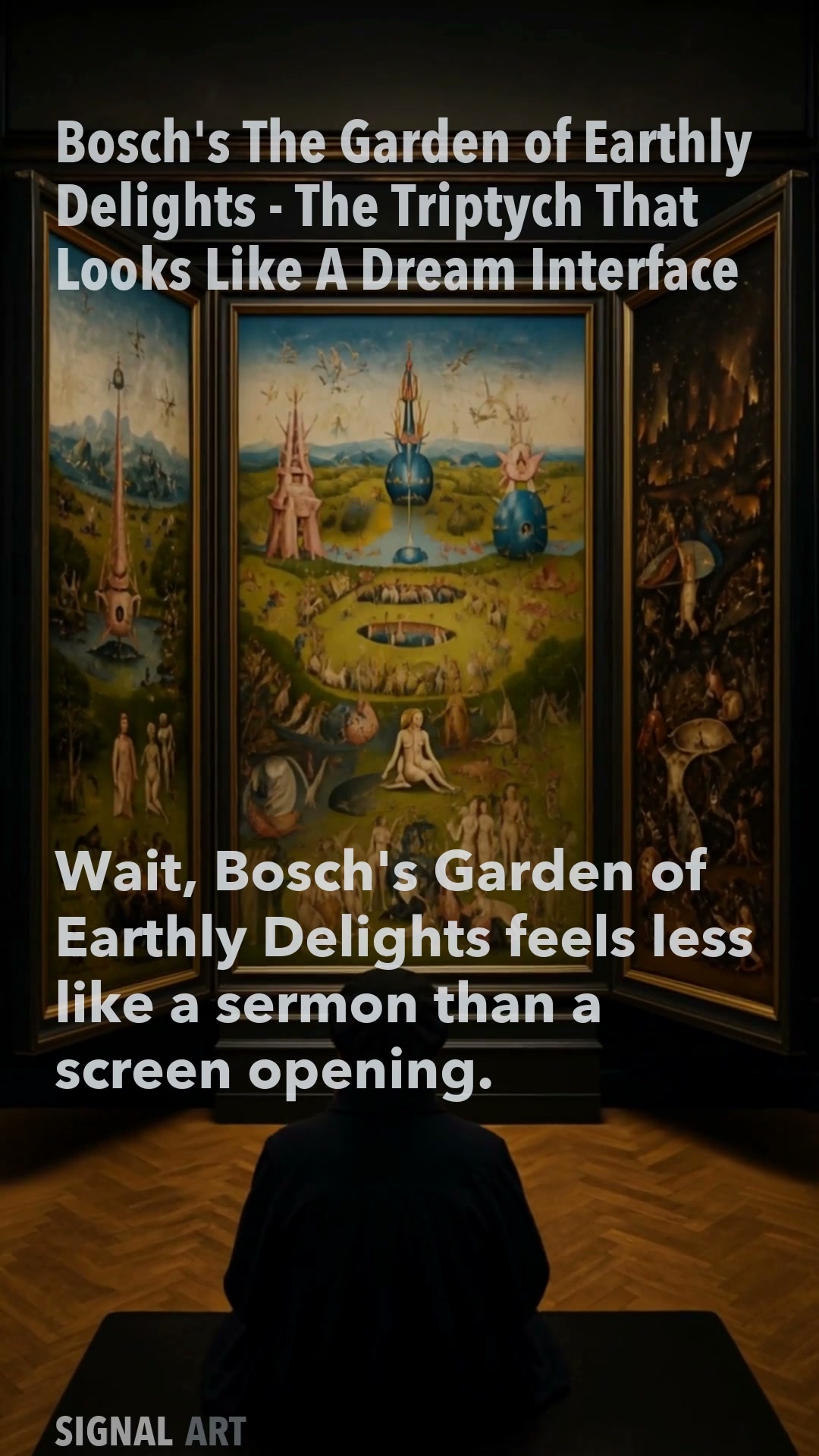
Wait, Bosch's Garden of Earthly Delights feels less like a sermon than a screen opening. Paradise, pleasure, and punishment appear together, so the eye must choose its path before judgment begins.
The shock is density. Tiny bodies, glass spheres, fruits, birds, and machines repeat like interface icons. Bosch makes moral confusion visible by making every detail feel clickable, tempting, and unstable.
Painted around 1490 to 1510, the triptych mattered because its meaning unfolds through scanning. The Prado picture does not hand you a message; it makes wandering the method, slowly, almost physically, across painted thought.
That is why it feels modern. Bosch turns sin into information overload: a world where desire organizes the screen, attention becomes a test, and looking too quickly is already failure.
Key facts
- The Garden of Earthly Delights was made by Hieronymus Bosch.
- The work is associated with c. 1490-1510 and Northern Renaissance.
- A major version or holding is associated with Museo del Prado.
- Bosch packs tiny figures, impossible creatures, transparent forms, and surreal architecture into a panoramic moral machine.
- The triptych is one of Bosch’s most famous works and is held by the Prado in Madrid.
Why it matters
It matters because it turns moral storytelling into immersive visual overload, a painting you explore more than simply view.
The Signal Brief
One sourced idea worth your attention, in your inbox. No noise.