The Hidden Adaptation Behind Bombardier Beetle
A beetle that explodes itself should die, right? The bombardier beetle does the opposite. When an ant attacks, it whips its abdomen around and blasts a hot, irritating spray straight back without harming itself.
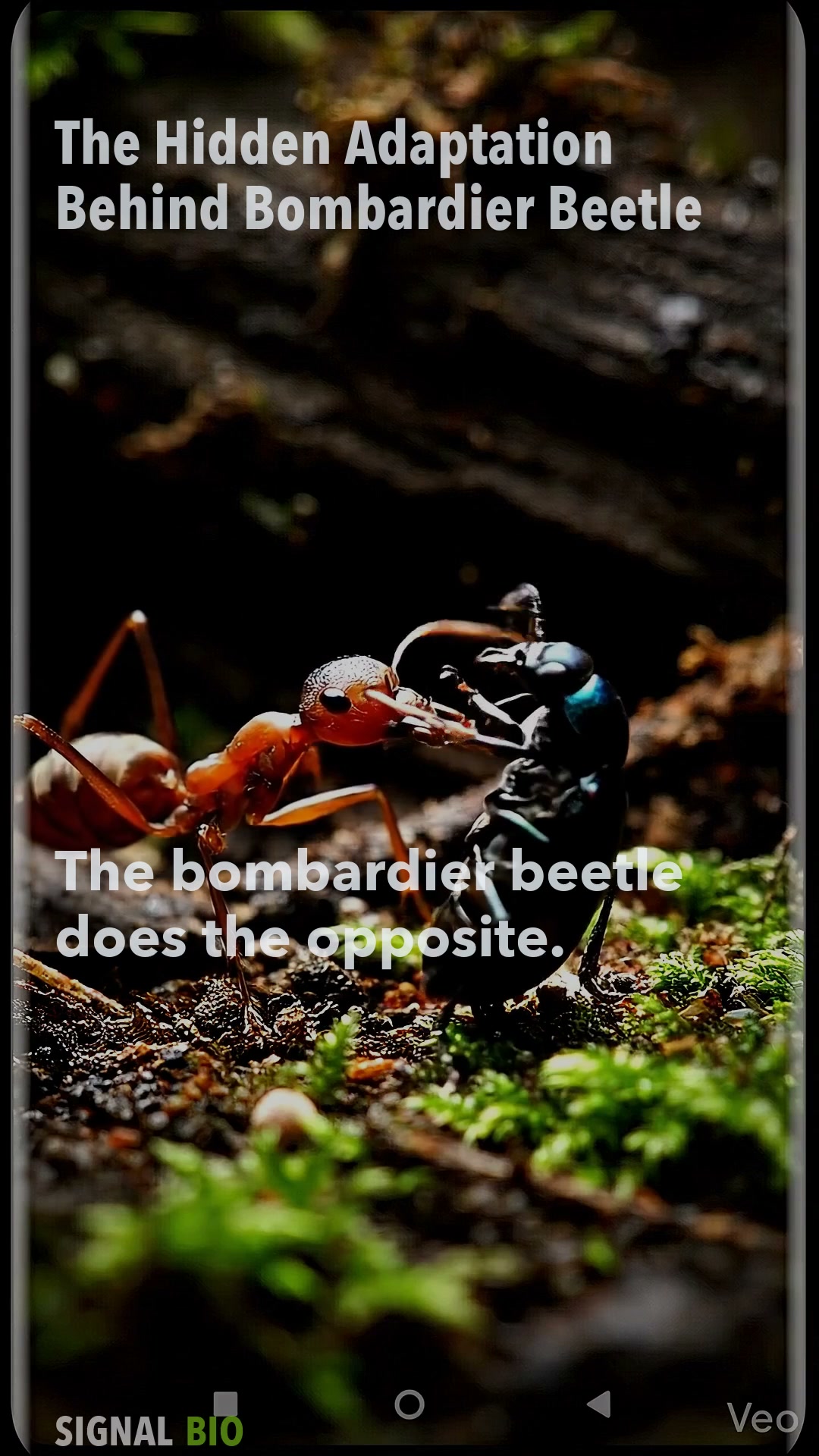
A beetle that explodes itself should die, right? The bombardier beetle does the opposite. When an ant attacks, it whips its abdomen around and blasts a hot, irritating spray straight back without harming itself.
That trick exists because fights happen at crushing distance. Ants grab, sting, and tear fast. The beetle cannot wait. Its defense has to fire during contact, and it starts by keeping dangerous ingredients separated inside the abdomen.
When danger hits, a valve opens. The chemicals rush into a reinforced chamber, enzymes trigger the reaction, the liquid boils almost instantly, pressure surges, and the chamber forces everything out through a narrow nozzle like a tiny turret.
So the marvel is not just the spray. It is the control. The beetle gives up body space to carry a tiny chemical engine, but one blast makes an ant recoil, groom, and retreat. Small body, precise explosion, smart escape.
Key facts
- A 12-scene natural-history explainer that begins with a bombardier beetle firing at an attacking ant.
- Then follows the survival problem inward through separated chemicals.
- A reinforced reaction chamber.
- Boiling toxic spray.
- Directional aiming.
Why it matters
And the tradeoff that lets a tiny beetle carry a tightly controlled chemical engine inside its abdomen. An ant rushes in across the forest floor, and the bombardier beetle does something extraordinary.
The Signal Brief
One sourced idea worth your attention, in your inbox. No noise.