Why SpaceX Would Pay $60 Billion for Cursor
Wild price, right? SpaceX may pay $60 billion for Cursor because Cursor is not really a code editor. It is the place where developers use AI every day, which makes it a control point, not just a tool.
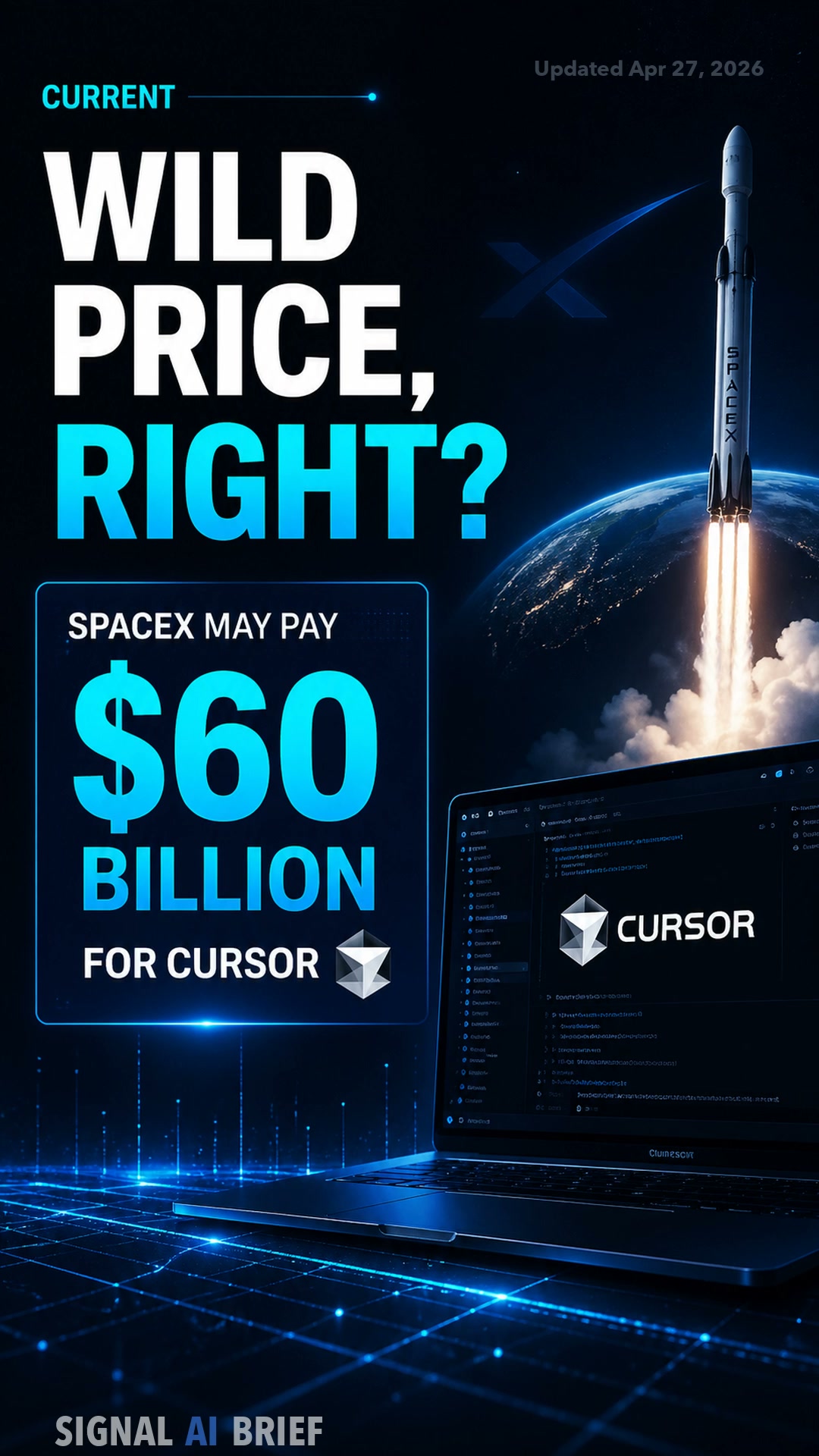
Wild price, right? SpaceX may pay $60 billion for Cursor because Cursor is not really a code editor. It is the place where developers use AI every day, which makes it a control point, not just a tool.
Cursor works by shrinking a giant codebase into the exact context a model needs. It maps functions, tracks changes, searches by meaning, follows dependencies, then proposes edits across files fast enough to feel conversational inside real work.
That is why Cursor is an interface business. Models can get cheaper and more interchangeable, but the tool developers live inside decides workflow, model choice, and daily habits. Own that layer, and you own distribution across software teams.
So the payoff is bigger than coding revenue. xAI gets a real product, enterprise customers, and a stronger lane against OpenAI and Anthropic. SpaceX gets something rarer: a serious software story that could reshape how investors value the whole company.
Key facts
- SpaceX was described as offering either a $10 billion partnership payment to Cursor or a later outright acquisition for $60 billion.
- The source described Cursor’s valuation progression as roughly $2.5 billion, then $9 billion, then $29 billion, then $60 billion over about 15 months.
- The source explained Cursor as indexing local repositories, parsing code with Tree-sitter, tracking changes with a Merkle-tree approach, and using vector search through Turbopuffer.
- The source claimed Cursor can modify multiple files, update tests, and present a clean diff for one-click application.
- The source said raw code does not leave the machine, while vectors go to the server and file names are obfuscated with chunks encrypted.
Why it matters
If the interface layer becomes the control point for model choice and developer workflow, owning Cursor could provide durable distribution even as models become more interchangeable.
The Signal Brief
One sourced idea worth your attention, in your inbox. No noise.