GPT-5.5: Faster Agentic Work, Higher Price, Bigger Real-World Leap
Wait, GPT-5.5 costs more? Yes, because OpenAI is selling a worker, not just a chatbot. It rolls into ChatGPT and Codex, takes a goal, uses tools, checks itself, and pushes computer tasks toward done.
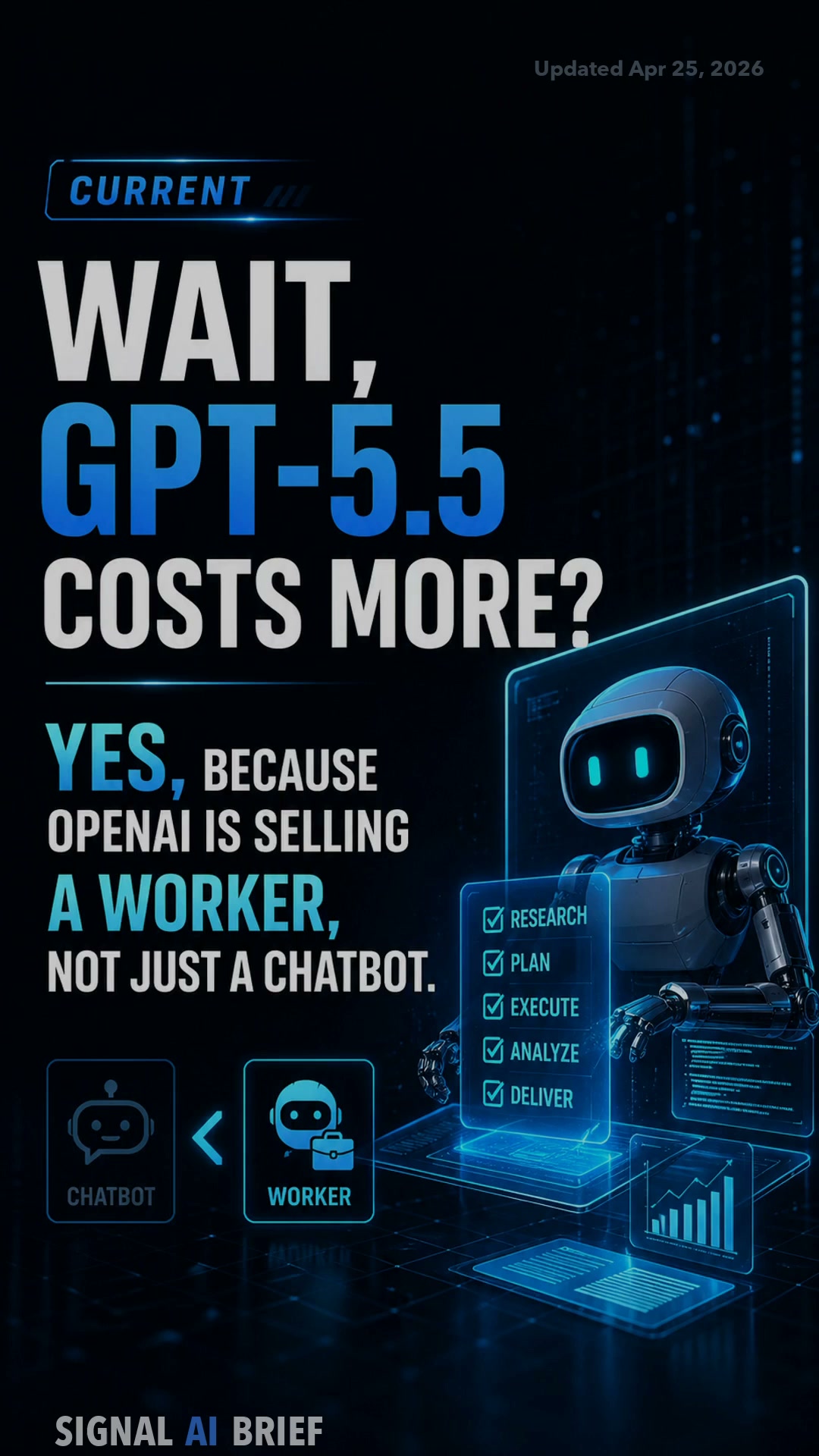
Wait, GPT-5.5 costs more? Yes, because OpenAI is selling a worker, not just a chatbot. It rolls into ChatGPT and Codex, takes a goal, uses tools, checks itself, and pushes computer tasks toward done.
The bigger shock is speed did not slip. GPT-5.5 matches GPT-5.4 on latency, hits 84.9% on GDP Val, and scores 78.7% on OS World, above the 72.4% human baseline for driving a computer.
That matters because this model is built for messy work: coding, browsing, documents, spreadsheets, even direct computer control. It also uses fewer tokens on Codex tasks, which means fewer loops, fewer corrections, and less wasted context.
So yes, the API price jumps: $5 and $30 per million tokens, or $30 and $180 for Pro. The real question is cost per finished job, and GPT-5.5 makes that tradeoff much harder to dismiss.
Key facts
- GPT-5.5 is rolling out to ChatGPT and Codex and is positioned as a model for real-world agentic work.
- GPT-5.5 matches GPT-5.4 on per-token latency in real-world serving while using significantly fewer tokens to complete the same Codex task.
- GPT-5.5 scored 84.9% on GDP Val, an evaluation spanning real-world tasks across 44 professions.
- The announcement notably led with Codex, underscoring that GPT-5.5 is being framed first as a model for practical computer work rather than only chat.
- The source highlights that token efficiency matters as much as raw benchmark scores because real-world usefulness depends on finishing tasks with less context and fewer revisions.
Why it matters
GPT-5.5 pushes AI further from isolated question answering into end-to-end execution across knowledge-work tasks.
The Signal Brief
One sourced idea worth your attention, in your inbox. No noise.